Elephant Conservation |
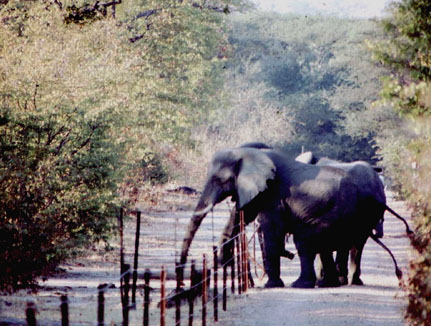
The restoration of elephant metadynamics in southern Africa may be instigated through the identification and delineation of a megapark or megaparks, possibly including the development of transfrontier conservation areas (TFCAs) along an ecological gradient. Within these megaparks natural forces and not current management actions (which controversially include culling, contraception and translocation) should limit populations. By closely monitoring elephant demography throughout southern Africa, the integrity of present elephant populations may be evaluated and distributional limitations identified. Knowing such limitations, actions can be used to develop and reinstate metadynamics and to ensure the viability of elephant populations either as a source or a sink component of a metapopulation. This stands to benefit elephant conservation, as well as all other biological components of the savannahs in the subregion. CERU is presently committed to a research programme that will facilitate the development of megaparks across southern Africa within the confines of the distributional range of elephants. As such, CERU’s elephant programme is dedicated to the study of elephant populations in South Africa, Mozambique, Botswana, Namibia, Zambia and Malawi. Specific conservation areas in which we are monitoring elephants include Maputo Elephant Reserve and Limpopo NP (Mozambique), Kruger NP and Tembe Elephant Park (South Africa), Etosha NP and Khaudom GR (Namibia), Kafue NP, South Luangwa NP, North Luaungwa NP and Lower Zambezi NP (Zambia), Nyika NP, Kasungu NP and Vwaza Marsh GR (Malawi) and the Okavango Panhandle (Botswana). CERU also collaborates with scientists working on similar projects in the Kunene District of northern Namibia. Several of these conservation areas are incorporated into newly established TFCAs such as the Great Limpopo Transfrontier Park, Kasungu-Lukusuzi TFCA and Nyika TFCA complex. Others such as the Kavango-Zambezi Transfrontier Conservation Zone are earmarked for TFCAs. The programme addresses the ecological delineation of megaparks that will lend optimal protection to a maximum complement of biological diversity. It uses the elephant as a flagship species and attempts to identify source and sink populations throughout the region, while gradients of habitat heterogeneity need to be maintained between these source and sink populations for them to function as a conservation management tool. This approach should benefit the conservation of diversity without conflicting with existing conservation priorities and tourism interests. At the same time it aspires to develop conservation capacity throughout southern Africa and serves as a platform for the exchange of information to consolidate existing and new research projects on elephants. The programme benefits from close collaboration with scientists associated with the Nicholas School of the Environment and Earth Sciences at Duke University. The restoration of the Maputaland elephant population, Mozambique The coastal plains of southern Mozambique and KwaZulu-Natal support fragments of the former Maputaland elephant population in the Maputo Elephant Reserve, the Futi Corridor and Tembe Elephant Park. These remaining fragments of a population that used to roam as far south as the White Umfolozi River are now separated from each other, either through man-made barriers. These fragments suffered from heavy poaching during the previous two decades. The return of agricultural activity to the region at the end of the Mozambique civil war resulted in conflict between elephants in areas around the Maputo Elephant Reserve where elephants damaged crops. The Peace Parks Foundation is currently attempting to negotiate the establishment of a Transfrontier Conservation Area (TFCA) across the Maputaland-Mozambique border. The establishment of such a TFCA that would link the Maputo Elephant Reserve in southern Mozambique with the Tembe Elephant Park in northern KwaZulu-Natal through the Futi Corridor will, at least in part, restore the fragmented elephant population of the region. It will also address the conservation and developmental needs of a poverty stricken region with exceptionally diverse vegetation. The delineation of the TFCA should be dictated by the ecological integrity, and thus viability, of the system. CERU’s research is directed at quantifying the variables that will facilitate political decisions about land use that will make possible the coexistence of elephants and people in the region. The study aims at assessing the interactions between elephants, people and their environments. It focuses on elephant and human population trends, their impacts on the vegetation of this centre of plant endemism and on landscape and habitat variables that will determine future trends. The integrity of the elephant population of the Kafue National Park, Zambia Kafue National Park (about 22 000km2) harbours an array of mammals ranging from widely distributed species that are not experiencing the threat of local or regional extinction, to regionally vulnerable species such as roan and sable antelopes. The Park is a potentially important tourist destination in Zambia and may contribute significantly to its economy. In spite of this, conservation research in Kafue is severely hampered by a lack of financial and manpower resources. The Kafue National Park and the surrounding Game Management Areas in southern Zambia may be somewhat different to other conservation areas in the southern African region. Here the lack of conservation capacity and infrastructure has given rise to a decline in the elephant population at an intrinsic rate of about 22% per year since 1997. Our preliminary observations suggest that some 2000 elephants live in isolated fragments in a southern and northern sub-population. These fragments also appear to be isolated from populations further to the south in Botswana and Zimbabwe. This apparent isolation is surprising as elephant populations in Zimbabwe and Botswana are increasing rapidly and may be extending their ranges. Human-induced disturbances in and around Kafue may have reduced the elephant population to densities where its activities are limited to sheltered areas, or to levels at which potential habitats are no longer being fully occupied. Man-induced pressures such as habitat modification may also be responsible for the apparent isolation of this population from others in the region. These ideas, however, remain speculative and need scientific verification prior to implementing a more up to date conservation management plan for the area. It is obvious, however that Kafue National Park, through potential corridors linking it with Botswana, Zimbabwe and parts of Namibia to the south is of special importance in the potential development of a system of TFCAs. These will meet the ideals of a new paradigm of conservation management through the reinstatement of metadynamics within the limits of megaparks. The population biology of elephants in the Etosha National Park, Namibia In Etosha National Park the placement of artificial water points throughout most of the reserve to stimulate wildlife populations and satisfy tourism, has given rise to noticeable changes in vegetation structure and possibly composition. Pressure currently exists to further increase the number of water points. Etosha, through corridors linking it with Damaraland to the west and potentially Kaudum National Park to the east, is of special importance in the potential development of a system of regional TFCAs and megaparks. Not only will it serve as an important source area for such development, but also provide for the establishment of an ecological gradient along which meta-population dynamics may be re-established. CERU’s research and development programme aims at enhancing the local capacity in conservation ecology and to stabilize conservation initiatives for the benefit of Namibia and the southern African region as a whole under the banner of the development of a regional conservation management alternative for the savannah elephant. Human–elephant conflict along the Okavango Panhandle The Okavango Panhandle has a long history of conflict between humans and elephants. This conflict results from elephants having to cross extended agricultural landscapes situated between their foraging grounds and sources of fresh water along the eastern side of the panhandle. Both human and elephant populations are increasing in Botswana and the conflict is exacerbated with the expansion of agriculture in the area. CERU is currently investigating this human-elephant conflict. Our research aims at assessing the current status of human and elephant interactions in the area. Further, it seeks to evaluate the factors underlying the conflict. Finally, it seeks to develop a management schedule that will minimise the apparent conflict between elephants and humans along the Panhandle.
|