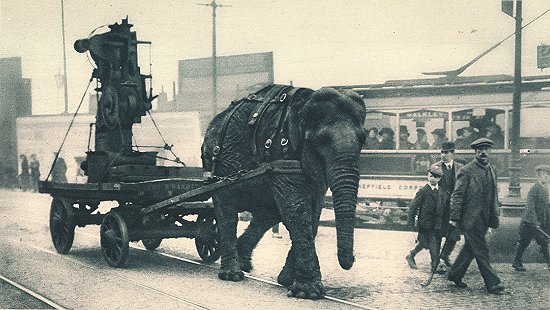
 Elephant taming began in the Indus valley around 4,000 years ago. Taming is not used here as a synonym of domestication. Domesticated animals, such as cows or dogs, are born in captivity and eventually subjected to selective breeding. Elephants, probably due to their bad temper, expensive feeding and slow growth rate (15 years to adulthood), were, with very few exceptions, always caught in the wild and subsequently tamed for several purposes. The first species to be tamed was thus the Asian elephant, for agricultural ends. The first military application of elephants dates from around 1100 BC and is mentioned in several Sanskrit hymns.
Elephant history |
From the East, war elephants migrated to the Persian empire where they were used in several campaigns. The battle of Gaugamela (October 1, 331 BC), fought against Alexander the Great was probably among the first confrontations of Europeans with war elephants. The fifteen animals, placed at the centre of the Persian line, made such an impression on the Macedonian troops that Alexander felt the need to sacrifice to the god of fear in the night before the battle. Gaugamela was Alexander's greatest success, which he won by carefully placing his cavalry away from the elephants. Following his conquest of Persia, Alexander recognised the use of the animals and incorporated a number of them in his army. Five years later, in the battle of the Hydaspes River, although without his own, Alexander already knew how to deal with elephants. The successful military use of elephants spread across the world. The successors to Alexander's empire, the Diadochi, used hundreds of Indian elephants in their wars. The Egyptians and the Carthaginians began taming African elephants for the same purpose, while the Numidians used the Forest elephant. The African savannah elephant, larger than the African forest elephant or the Asian elephant, proved too difficult to tame for war purposes and was never widely used. Elephants used by Egyptians at the battle of Raphia in 217 BC were smaller than their Asian counterparts, but that did not guarantee victory for Antiochus III the Great of Syria. In the next centuries, further use of war elephants in Europe was mainly against the Roman Republic. From the battle of Heraclea (280 BC, Macedonian Wars) to the famous march across the Alps by Hannibal during the Second Punic war, elephants terrified the Roman legions. Like Alexander, the Romans found a way to cope with the dangerous elephant charges. In Hannibal's last battle (Zama, 202 BC), his elephant charge was ineffective because the Roman maniples simply made way for them to pass. More than a century later, in the battle of Thapsus (February 6, 46 BC), Julius Caesar armed his fifth legion (Alaudae) with axes and commanded his legionaries to strike at the elephant's legs. The legion withstood the charge and the elephant became its symbol. A reportedly effective anti-elephant weapon was the pig. Pliny the Elder reported that "elephants are scared by the smallest squeal of a pig" (VIII, 1.27). A siege of Megara was reportedly broken when the Megarians poured oil on a herd of pigs, set them alight, and drove them towards the enemy's massed war elephants. The elephants bolted in terror from the flaming squealing pigs. In the Middle Ages, elephants were seldom used. Charlemagne took his elephant, Abul-Abbas, when he went to fight the Danes in 804, and the Crusades gave Frederick II, Holy Roman Emperor the opportunity to capture an elephant in the Holy Land, later used in the capture of Cremona in 1214. It was the use of elephants, again by an Indian Sultanate, that almost put an halt to Timur's conquests. In 1398 Timur's army faced more than one hundred Indian elephants in battle and almost lost by pure fear of his troops. Historical accounts say that the Turks won due to an ingenious strategy: Timur set flaming straw on the back of his camels before the charge. The smoke made the camels run forward and scared the elephants, who crushed their own troops in an attempt to retreat. Another account of the campaign (that of Ahmed ibn Arabshah) reports that Timur used oversized caltrops to halt the elephant charge. Later, the Turkic leader used the animals against the Ottoman Empire. With the advent of gunpowder warfare in the late 15th century, war elephants became obsolete as a charging element because they could be easilyknocked down by a cannon shot. |