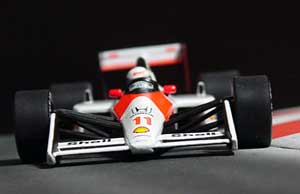
 Over the past 50 years, Formula 1 has written a remarkable history. Each era with its own legends and its own stories that not even a first class author could have come up with. On May 13 1950, the FIA started the first Formula 1 Championship after FIM had done the same for motorbike races.
Formel 1 history |
In the first decade of the Formula One World Championship, one name stands above all others: Juan Manuel Fangio. His five world titles are still the record to beat today. Present since the first World Championship is the legendary car constructor Ferrari, which has grown into a myth over these 50 years. Nowadays Formula One without Ferrari is something unthinkable. But the Italian domination didn't last forever. The challenge came from Great Britain. Constructors like Cooper, BRM, Vanwall and Lotus appeared on the grid. English drivers such as Stirling Moss, Mike Hawthorn and Peter Collins rose to the top. Cooper placed the engine at the rear of the car in 1959, and Jack Brabham won the title in this car. It marked the start of a new era with rear engined cars. This english revolution still has consequences today, because where else do you find all the F1 constructors? The British set the tone in the sixties. Though Ferrari won the titles in 1961 and 1964, it was Graham Hill and Jim Clark that gave the era its flair. BRM and Lotus built the fastest cars until Jack Brabham returned with his own construction. Jack Brabham is the only man to win the world title in his own car, and that will undoubtedly be an eternal record. After Brabham wrapped up 2 World Titles, Formula 1 was ready for another revolution. In 1968, we saw for the first time wings on the cars. This was paired by the first commercialisation of the sport. Sponsors appeared on the cars. This was possible thanks to the customer Ford Cosworth engine and a certain car constructor called March that built cars and sold them. A certain Max Mosley was part of this March project. The turn of the decade saw unfortunately Formula One's only posthumous World Champion Jochen Rindt. The cars became ever faster and more dangerous and for the first time safety was really brought up by none other then Jackie Stewart, triple World Champion. And just 3 years later, after Niki Lauda's notorious Nürburgring fireball crash that left him badly burnt, safety became a priority. But the seventies were also known for the craziest technical evolutions. Cars with 6 wheels, giant airboxes, gas turbine engines and cars with giant fans to suck them to the ground! Most of these technical evolutions were banned in the "interest of the sport". However, one technical evolution stayed and eventually became a standard. Renault had entered the sport with a Turbo engine, and after a few years, the other teams started to follow in their footsteps. At the same time, there was a fight brewing between the FIA and FOCA. The FIA wanted ground effects banned for safety reasons. The FOCA led by Bernie Ecclestone thought this would give advantage to the turbo powered cars such as Renault and Ferrari. The FOCA teams (such as Williams, Lotus,..) boycotted the San Marino GP while the FIA rendered the Spanish FOCA organized GP invalid. The differences between FIA and FOCA were eventually settled by the Concorde Agreement. Yes, Bernie had left his first mark on the sport and has been the major influence on how modern day Formula 1 is run. The eighties saw McLaren with Ron Dennis rise to power. By the end of the decade, McLaren was practically undefeatable, winning no less then 6 titles between 1984 and 1989. It was also marked by the fierce battle between Alain Prost and Ayrton Senna. McLaren and Senna continued to dominate into the nineties, until the powerful Honda withdrew their engine supply and Williams with Adrian Newey built superior cars. So superior that Nigel Mansell had wrapped up the World title with still 6 races to go! The technical evolution of F1 had increased immensely. Cars now had active suspension and traction control and many other driver aids. The fear that the driver would become obsolete grew bigger and for 1994, FIA planned some changes and banned most of these technologies. However 1994 is a year not many will forget, for in a dark weekend at Imola, F1 lost Ratzenberger and Senna. Perhaps F1 had thought itself invulnerable as it was 12 years since the last fatality in a F1 race. FIA had to react and more changes for more safety were introduced. With the death of Senna, F1 had a sudden generation shift and a new era began.. the era Schumacher. And with Ferrari approaching a 20 year drought in world titles, they hired the then double world champion to bring Ferrari back to glory. But the opposition was not easy and it wasn't until the year 2000 that Ferrari could call itself Champion again. The last few years have seen the latest trend in Formula 1: big car constructors get involved. Jaguar, Honda, Renault and also Toyota are entering F1. All have the same goal.. to become World Champion.. but not all will achieve this! Who will win and who will lose will eventually be added to the glorious history of Formula 1. The First Races: Competitive motor racing began very soon after the invention of the first successful petrol-driven car. Although the internal combustion engine had been invented in Germany and it had been Britain that had led the industrial revolution, both countries were initially hostile towards the motor car. So it fell to France to lead the way in the creation of motor sport. The first motor car 'reliabilty' trial was organised by the French newspaper 'Le Velocipede' in 1887. The event involved a short run from Paris to Versailles. Unfortunately only one competitor showed up and the event had to be abandoned. In June 1894 Pierre Gifard, editor of the newspaper Le Petit Journal, announced the running of a reliability trial between Paris and Rouen. A prize of 5,000 francs was offered for the car which, crewed by a driver and mechanic, completed the course safely and with the minimum of expense. A total of 21 cars started the race from the Porte Maillot in Paris on July 22nd. It was to be a gentlemanly affair with the competitors making the 80 mile trip to Rouen - including a brief stop for a spot of lunch! First home was the Comte de Dion in a steam driven tractor. He completed the course at an average speed of 11.58 mph. However the organisers considered his vehicle to be impractical and as he did not have a mechanic on board he was unable to claim the prize.
|