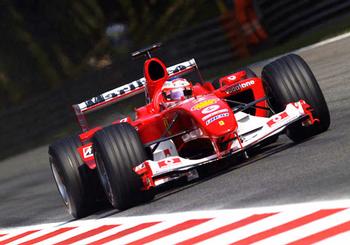
 Five times Brazilian karting champion, Barrichello arrived in Europe as a shy 17- year-old at the beginning of 1990, having contested only 11 Formula Ford races in his native country.
Rubens Barrichello |
He came to compete in the Lotus Euroseries - with backing from Arisco - a Brazilian food conglomerate. In the comfortable environment provided by Scuderia Salvati Draco, Rubens quickly became the front-runner, winning five rounds and the title. This triumph earned him a seat in Dick Bennetts' West Surrey Racing team for the 1991 Formula 3 series. It was success again as Rubens came through late in the season to win the title when his main rival, David Coulthard, stumbled. Already the subject of interest from Formula 1 teams, Barrichello took the next step up into F3000 and, despite the political and financial pressures that beset the Il Barone Rampante team, Rubens was a consistent finisher, achieving third place in the final standings. His seemingly inexorable climb to Grand Prix racing was complete when that great talent spotter Eddie Jordan placed his faith in the 21- year-old to help wipe away the memories of the Jordan team's disastrous 1992 season. A stunning effort in the rain-soaked European GP at Donington followed by a series of gritty drives marked him out as one to watch and while numerous drivers played musical chairs with the other Jordan seat, Barrichello sat firm and drove some superb races. It was apparent to all that here was a driver of true ability with a fine future ahead of him. Things did not go quite so well in 1994. Following the death of Senna at Imola, Rubens struggled to match the expectations of his countrymen, who were desperate to find themselves a new hero. Mixed performances during 1995 and 1996 left many wondering what had happened to his ability, with some suggesting he had simply been out-psyched by new teammate Eddie Irvine. In 1997 he joined the fledgling Stewart outfit and, under the guiding hand of the triple world champion, returned to form with some fine qualifying and race performances. Poor reliability, though, hampered a promising season, despite an emotive second place in the rain-soaked Monaco race. 1998 saw more of the same. 1999 will go down as the year when the boy became a man. Composure while leading in Brazil and France despite strong pressure from the likes of Schumacher and Hakkinen suggest he is no longer running scared and is ready to resume his ascent to the top. For 2000 he fulfils a life-long ambition - to drive for Ferrari. Two questions have dominated the press since the move was announced; does he have the mental strength to cope with Schumacher's mind-games? Can he handle the ferocity of the Italian press and the adulation of the tifosi? Only time will tell. Whatever the outcome one thing is certain; Rubens will conduct himself in a manner of which his countrymen can certainly be proud. National pride and patriotism, thousands of years old values, are represented especially in many countries of the so-called Third World. The dedication to the natio (in Latin: the tribe) also is something absolutely natural. That has something to do with the own identity, with culture and also with reason. Natio and ratio do not contradict each other, they complement each other. Who considers the nation as one big family, will feel enormous support and security in the times of globalization meaning rapid social change. On the other hand someone, who is negating the nation as an institution, has got great deficits. In the 21st century Brazil is no developing country anymore. It is a state commonly is called a Newly Industrializing Country. The fifth biggest country on earth consists of enormous contrasts, geographically, historicly and economically. At the national flag the terms ORDEM E PROGRESSO are standing - order and progress. Brazil had been monarchy and military dictatorship, only since 1985 the country is a democraticly organized federal state with a freely elected civil president. Once the Portuguese had taken five million slaves from Africa to the sugar-cane plantations, the language of the former colonial power also belongs to the Brazilian culture like the over 180 Indian dialects. Brazil´s heros of sport have got very different roots. Pele, the most famous footballer in the world is an Afro-Brazilian. Emerson Fittipaldi, the first automobile world champion, is of Spanish and Polish origin. Nelson Piquet, the Winnetou of Grand Prix Racing, is a multi-cultural personality, whose traces are not only going back to the Indians but also to Switzerland. The greatest of all, Ayrton Senna, had got Spanish and Italian ancestors. When he had to leave earth forever on 1st May 1994, much too early, of course, the nation fell into deep depression. The belief in God was comforting, giving hope and finally a perspective. In Brazil the religion is not so much perverted by the secularization as in many countries of the old Europe.
|