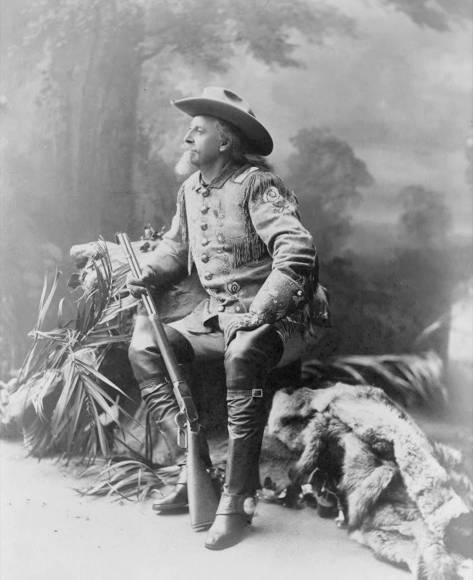
Buffalo Bill |
Born: February 26, 1846 William Frederick Cody, known as Buffalo Bill, was a buffalo hunter, U.S. army scout, and an Indian fighter. But he is probably best known as the man who gave the Wild West its name. He produced a colorful show called Buffalo Bill's Wild West and Congress of Rough Riders of the World, which had an international reputation and helped create a lasting image of the American West. Buffalo Bill was a major contributor in the creation of the myth of the American West, as seen in Hollywood movies and television. William Frederick Cody, known as Buffalo Bill, was a buffalo hunter, U.S. army scout, and an Indian fighter. But he is probably best known as the man who gave the Wild West its name. He produced a colorful show called Buffalo Bill's Wild West and Congress of Rough Riders of the World, which had an international reputation and helped create a lasting image of the American West. Buffalo Bill was a major contributor in the creation of the myth of the American West, as seen in Hollywood movies and television. Part of this inscrutability derives from Cody's relentless desire to become Buffalo Bill. As we have seen, fact and fiction intertwined so tightly in the Wild West Show that the two became indistinguishable from one another. This same blending spilled over into Cody's personal life as his real identity became confused with the character of Buffalo Bill. One problem is that Cody so aggressively promoted his enterprise that he was almost always "on stage" as Buffalo Bill. In New York, San Franciso, Chicago, and Europe, Cody's savvy for publicity essentially required that he maintain his character anywhere he went. In his day, he was a national hero, a role model, and a living legend. Slipping out of character or dashing the public's expectations of him might have led to the ruin of his empire, or so it seems Cody believed. Buffalo Bill represented the quintessential American through his embodiment of frontier values and all the raw independence, freedom, and self-sufficiency included in wild west virtues. As the nation become increasingly industrial and as waves of immigrants descended on American shores, Buffalo Bill became the very symbol of the American spirit. Cody recognized the burden he carried, but relished the responsibility of shouldering it. Still, there was more to Cody than his legend, and in fact, his Wild West Show was to Cody a source of capital to finance the many other ventures he initiated. Outside of the entertainment industry, Cody's most significant project was that of developing the town of Cody, Wyoming. In Cody's scouting days, he grew enamored of the land in Big Horn Basin. In 1895, Cody began to establish his eponymous town, and his approach to development was remarkably similar to the making of the Wild West Show. Cody possessed a broad, comprehesive, and inventive vision for his community. He imagined a utopian western metropolis where old west values and emergent modern technology and prosperity would coexist in a new "White City." Cody's indefatigable pursuit of his envisioned ideal was indeed impressive. He hustled, lobbied, and wheeled-and-dealed anyone who could help him achieve his goal. He had organized financing to dig three canals to irrigate the land using the Shoshone River. When his initial efforts to raise the two million dollars necessary for its completion failed, he hounded his friend Teddy Roosevelt for support. By 1904, the Department of Interior initiated the Shoshone Reclamation Act, and by 1910, two dams were in operation, and 16,200 acres were under irrigation. In 1876, while scouting for the army in western Nebraska, he fought a famous duel with a Cheyenne warrior named Yellow Hand or Yellow Hair. It is rumored that Cody killed and scalped the warrior, according to the correct native custom, for which he later received the Congressional Medal of Honor. THE LEGEND LIVES ON Buffalo Bill’s legacy is with us still. Before Hollywood Westerns, before the defining scholarship of Frederick Jackson Turner, before television cowboys, Cody’s Wild West created a national memory of the American frontier experience. Few of the millions who thrilled to the drama of Indians and animals, heroes and villains, and perils and rescues had any first-hand experience with that brief, colorful period in American history. Yet because Cody’s exhibition was cut from authentic cloth, with real characters reenacting real events, generations of Americans felt they had participated in the opening of the frontier. Cody himself embodied the virtues that defined the heroic frontier scout: courage; optimism; the triumph of man over nature; and the inevitability of Western civilization over savagery. Where Cody’s friend Mark Twain was an observer of the West, Cody was a direct participant. Another prominent friend exalted in the drama, values, and virtues played out in the Wild West, and borrowed from it the name “Rough Riders” for the troops he would lead up San Juan Hill. Theodore Roosevelt visited with Cody in Wyoming, and the old showman lunched with the President at the White House. Beyond his personal reach, Cody’s Wild West helped frame how America saw itself in the world. His orchestrated mythology of good over evil and of galloping to the rescue echoed through the 20th century. It can be seen in the expansionism of Theodore Roosevelt, American engagement in both World Wars, the decadeslong confrontation with Communism, and even in Lyndon Johnson’s vain hope that just a few more troops around the wagon train might carry the day in Vietnam. In the 1980s, Ronald Reagan, a canny performer himself, used Western stagecraft and metaphor to help revive America’s sense of righteous determination. The current war against terrorism is a new frontier, as rugged and dangerous as any in the Old West. It is significant that Cody, the decorated Indian fighter, made clear distinctions between the warriors he fought and the culture from which they came. When the shooting stopped, he befriended Sitting Bull. In later years he spoke out on behalf of Native Americans. Likewise, we are assured that the war today is waged against a radical few, not Islam or Arabs.We drop food along with bombs. Yet we thrill to images in The New York Times of American Special Forces in Afghan native dress, galloping on horseback across the open plains on the far side of the world. The metaphors and archetypes through which America defines itself in the modern world flow from many sources.Among them must be counted the buckskinned scout who, for generations, defined the spirit of the Wild West.
|