Emmet Starr dreamed of becoming "the Herodotus of the Cherokees." Ironically, however, even though his
History of the Cherokee Indians (1922) remains in print and has been called the "single most valuable source of authentic material on the personal history and biography of the Cherokee people," the historian died in a two-room walk-up apartment in St. Louis, convinced that he was a failure.
In many ways Starr was typical of the citizens of the Cherokee Nation who were born in the period immediately following the American Civil War. The independent political entity that was the Cherokee Nation was coming to an end as young Starr was approaching manhood. The invasions of railroads and white intruders were under way, and both sought to destroy the prewar Indian empire. By 1907 the Cherokee Nation had become a part of the state of Oklahoma. Students of Cherokee history know of the removal of the tribe from Georgia over the "Trail of Tears," but few realize that the influx of settlers following the Civil War was equally disastrous for the ultimate survival of the tribe.
Emmet Starr, the eldest son of Walter Adair Starr, was born in the Going Snake district, Cherokee Nation, Indian Territory, on December 12, 1870. Both his parents were mixed-blood Cherokees well versed in the history and traditions of their distinguished families. Starr was educated in the Cherokee public schools and graduated from the Cherokee Male Seminary in 1888. He received a degree in medicine from Barnes Medical College at St. Louis in 1891. Starr devoted himself to a variety of careers and never married.
Starr began gathering materials for his History of the Cherokee Indians in about 1891. For five years he practiced medicine, but in 1896 he began to devote himself full-time to becoming the Cherokee Nation's historian. Starr also served one term on the Cherokee National Council as a representative of the Cooweescoowee district and as a delegate to the Indian Territory statehood meeting known as the Sequoyah Convention. Active in the movement to avoid the abolition of Indian territory and create a separate Indian state, Starr considered the congressional rejection of the proposed state of Sequoyah and the subsequent creation of the state of Oklahoma a major blow to the Indian people. With the admission of Oklahoma to the Union in 1907, the Cherokee Nation ceased to exist; this marked the end of an era for the Cherokee people. Though some Cherokee leaders successfully made the transition from tribal government to statehood, many more did not. Hundreds who might have been leaders in Cherokee district government or prominent in the Cherokee National Council chose not to participate in the affairs of the new state. Gradually, the Cherokees began to lose their sense of being a nation.
Despite the Cherokees' loss of tribal status, however, Starr continued the preparation of his histories. He often worked with the support of the Cherokee National Seminaries and Normal School (now Northeastern State University) in Tahlequah. He published four books. His first, Cherokees West (1910), is essentially a reprint of the memoirs of the Western Cherokee missionary and leader Cephas Washburn and a collection of Cherokee laws. A very rare volume among his works is his second book, Encyclopedia of Oklahoma (1912). Prior to the publication of History of the Cherokee Indians (1922), without doubt his most significant and valuable contribution, he published a smaller volume, Early History of the Cherokees (1917), concerned primarily with the Arkansas or Western Cherokees.
In a sense, Starr's 1922 History is not a history at all. Its major value is as a source of primary documents and genealogical data on the Cherokee tribe. It includes descriptions of early colonial wars, Cherokee removal and civil war, the role of the Cherokees in the Texas Revolution and in the American Civil War, and hundreds of other events in Cherokee history. Much of this history comprises the texts of the laws, constitutions, and treaties of the Cherokee Nation. Many of these had never before been printed; others could be found only in Cherokee Nation publications, often printed in Sequoyah's Cherokee syllabary.
Starr began his research by turning to oral sources, supplementing them with exhaustive research using primary documents and books. He was both a field and a library researcher. As a Cherokee, Starr had access to oral and manuscript material that no white historian could ever have acquired. The tribe's confidence in Starr is reflected in his book's inclusion of previously unrecorded traditionalist Keetowah letters and pictures. Perhaps the most striking of these illustrations is one of the Keetowah Council of 1916 that shows the ancient Cherokee wampum belts, never previously exhibited.
Because of his commitment to Cherokee traditions, Starr was frequently at war with the Oklahoma historical establishment. At a time when much Indian history, especially the history of the Five Civilized Tribes, was being written as the story of inevitable "civilized progress," Emmet Starr wrote about the traditionalist Knighthawk Keetowahs as well as the Cherokees' frequently ignored achievements in government and education. At a time when the historian Grant Foreman cast Cherokee history as a tribute to acculturation, Emmet Starr dared to write of the pernicious influence of Baptist missionary groups on tribal life and to criticize the continuing power of missionaries.
Starr's 1922 History was in many ways a book of the turn of the century, although it was not published until later. It reflected an overwhelming concern with family and genealogy that was a part of the enrollment process for the Five Civilized Tribes. What today may seem an unreasonable concern with family was at the time the central issue of tribal existence. Starr began gathering material for his family histories as early as the 1890s, assembling genealogical data from Cherokee district courthouses, taking detailed statements from individual family Bibles, and tracing family lineage through wills, birth certificates, and property transactions. There are few Cherokee families who do not have at least one member who recalls Starr coming for a visit in his old buggy and staying for a night or even a week. Tribal tradition has it that "the Doctor" talked and listened, and talked and listened. Starr wrote, "I was afforded at an early age the opportunity of listening to the conversations and reminiscences of many of the most brilliant minds among my own people. I listened as a boy to . . . many . . . who were born reconteurs and savants." This childhood delight became the historian's principal method.
Having abandoned his medical career, Starr moved from job to job. The Indian Bureau office in Muskogee, the Northeastern Normal School (formerly the Cherokee Seminary) in Tahlequah, and the public schools of Rogers County furnished him with temporary employment. Starr sought more permanent employment with a variety of Oklahoma state agencies, especially with the Oklahoma Historical Society. The simple truth was that Starr was a man whose country was gone, destroyed as completely as if it had been bombed from the face of the earth. For Starr, and for other Cherokees of his age, the end of the nation was a blow from which they never recovered.
As is often the case, the merit of Starr's achievement was not widely recognized during his lifetime. Though he was, in fact, sad and lonely, some considered him eccentric. He was a man who, according to a friend of thirty-five years, "died as he had lived—misunderstood and, therefore, disappointed." Starr left Oklahoma for St. Louis sometime after World War I. There is poignancy in his letters written from St. Louis—a constant sense of his being in the wrong place. Again and again he writes of hearing little of Oklahoma, of the Cherokees. In 1929 he lamented, "I hear and know just as much about Oklahoma now as I do about China." And yet he never stopped thinking or writing or talking about his people and the state of Oklahoma, into which their political destiny had been merged. A friend from his last days in St. Louis recalled: "He liked to talk politics, especially as concerned Oklahoma. . . . He could tell stories concerning territorial and early statehood days in Oklahoma for hours at a time, and nothing seemed to please him more than to have an interested listener to these stories."
Emmet Starr was the Cherokee historian for all times. He performed one of the greatest services possible for the Cherokee people. Sequoyah, it is said, gave his people "talking leaves." Starr gave his people a recorded history. Starr's History of the Cherokee Indians is of more significance today than ever before. Those who can remember the historic greatness of Cherokee tribal government, education, and culture are almost gone. For the new generation, and for generations yet to come, Starr's History is a constant reminder of Cherokee achievements.
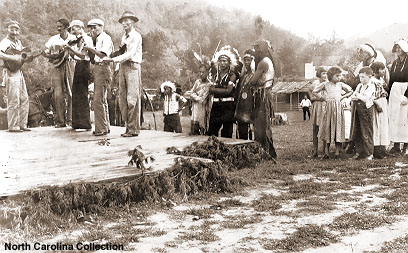 The Cherokees are original residents of the American southeast, particularly Georgia, North and South Carolina, Virginia, and Kentucky. Most Cherokees were relocated to Oklahoma in the 1800's by the infamous Trail of Tears, and the descendants of those who survived this death march still live in Oklahoma to this day. Some Cherokees escaped deportation by hiding in the Appalachian hills, or were sheltered by sympathetic white neighbors. The descendants of these people still live scattered throughout the original Cherokee homelands, particularly in North Carolina, where they have their own federally recognized tribe.