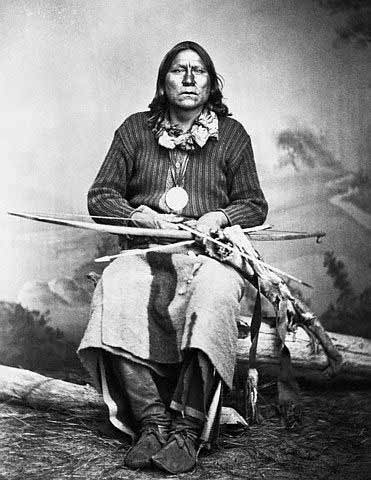
Kiowa indians |
white bear kiowa chief 1869-1874 Kiowa , Native North Americans whose language is thought to form a branch of the Aztec-Tanoan linguistic stock (see Native American languages). The Kiowa, a nomadic people of the Plains area, had several distinctive traits, including a pictographic calendar and the worship of a stone image, the taimay. In the 17th cent. they occupied W Montana, but by about 1700 they had moved to an area SE of the Yellowstone River. Here they came into contact with the Crow, who gave the Kiowa permission to settle in the Black Hills. While living there, they acquired (c.1710) the horse, probably from the Crow. Their trade was mainly with the Arikara, the Mandan, and the Hidatsa. After the invading Cheyenne and the Sioux drove the Kiowa from the Black Hills, they were forced to move south to Comanche territory; in 1790, after a bloody war, the Kiowa reached a permanent peace with the Comanche. According to Lewis and Clark, the Kiowa were on the North Platte River in 1805, but not much later they occupied the Arkansas River region. Later the Kiowa, who allied themselves with the Comanche, raided as far south as Durango, Mexico, attacking Mexicans, Texans, and Native Americans, principally the Navajo and the Osage. In 1837 the Kiowa were forced to sign their first treaty, providing for the passage of Americans through Kiowa-Comanche land; the presence of settlers in increased numbers accelerated hostilities. After 1840, when the Kiowa made peace with the Cheyenne, four groups—the Kiowa, the Cheyenne, the Comanche, and the Apache—combined to fight the eastern tribes, who had migrated to Indian Territory. This caused more hostility between Native Americans and the U.S. government, and U.S. forces finally defeated the confederacy and imposed the Treaty of Medicine Lodge (1867). This confederated the Kiowa, the Comanche, and the Apache and provided that they should settle in Oklahoma. However, parts of the Kiowa remained hostile until the mid-1870s. Oncoming American settlers, unaware of treaty rights, caused friction with the Kiowa, resulting in a series of minor outbreaks. In 1874 the Kiowa were involved in a serious conflict, which was suppressed by the U.S. army. American soldiers killed the horses of the Kiowa, and the government deported the Kiowa leaders to Florida. By 1879 most of them were settled on their present lands in Oklahoma. The Kiowa Apache,. a small group of North American Native Americans traditionally associated with the Kiowa from the earliest times, now live with them. The Kiowa Apache retain their own language. There were close to 9,500 Kiowa in the United States in 1990. Many twentieth-century Kiowas have served in the U.S. armed forces. In 1957-58, veterans of World War II and the Korean War helped revive two sodalities: the Kiowa Gourd Clan and the Black Leggings Warrior Society. The Kiowas are very active in southern plains powwows—particularly where the Gourd Dance is performed, for they see its performance as an expression of their tribal identity. The peyote religion had made inroads among the KCA Indians by 1870. Today many Kiowas participate in Native American Church ceremonies, but the majority attend community Baptist, Methodist, and Pentecostal churches. The Kiowas readily accepted Christianity, claiming that they already knew how to pray when full-time missionaries arrived in 1887. Bundle inheritance has broken down in the twentieth century, but the eleven tribal bundles are still consulted with prayer requests. The Kiowas are very tolerant of religious diversity, for they believe that Dwk'i, "Power Man" or "God," is in everything. Dwdw still exists; it merely assumes different guises. An important Plains tribe, constituting a distinct linguistic stock, the Kiowan, now located in western Oklahoma, but formerly residing in the mountains about the head of the Missouri River, in western Montana, in close alliance with the Crows. From this position they gradually drifted southward along the Plains, and after having been driven from the Black Hills region by the Sioux about 1800, made their principal headquarters upon the upper Arkansas. About the year 1790, they made peace with the Comanche, who whom they have ever since been closely confederated, and in company of whom they made constant raids far down into Texas and old Mexico, even as far as Zacatecas, until finally confined upon a reservation in 1869. In this southern movement they were accompanied by a small detached tribe of Athapascan stock, commonly known as Kiowa-Apache, who, in everything but language, are a component part of the Kiowa tribe. The Kiowa made their first treaty with the Government in 1837. In 1867 they joined with the Camanche, Cheyenne, and Arapaho in the noted Medicine Lodge treaty, in which they agreed to go upon a reservation, but it was not until the decisive battle of the Washita, under General Custer, 27 November, 1868, that they fulfilled their promise. Among their noted chiefs of this period were Setangya, or Satank, "Sitting Bear", Settainti or Satanta, "White Bear", the "orator of the plains", and "Gui-pägo", Lone Wolf. In the later troubles Setangya was shot to pieces while resisting military arrest, Settainti committed suicide in prison, and Lone Wolf, with a number of others, was deported to Florida for a period of three years. In 1873 the first educational work in the tribe was undertaken by the Quaker teacher, Thomas C. Battey, but he was compelled to desist a few months later, in consequence of the general outbreak of the confederated southern Plains tribes (1874-1875), in which Lone Wolf headed the hostile Kiowa. Since then there has been no serious disturbance. Since an agreement negotiated in 1892, but held up and finally modified before its final ratification in 1900, the reservation of the associated tribes was thrown open to white settlement, each Indian receiving an allotment of 160 acres, besides his share of the selling proceeds, and they are now American citizens. Before their subjection to reservation restrictions the Kiowa were a typical equestrian Plains tribe, living in buffaloskin tipis, wearing buckskin, with paint and feathers, depending almost entirely upon the buffalo for subsistence, without agriculture, pottery, basketry, or fixed abode, constantly raiding in every direction, and with a reputation even among Indians for turbulent ferocity. Their weapons were the bow, lance, and shield, which latter was made of toughened buffalo hide. There was no single head chief. Instead of a clan system (see Indians) they had a division into six (formerly seven) bands, including the Kiowa-Apache. On occasion of tribal gatherings, as at their great annual Sun Dance, each of these bands occupied an appointed place in the camp circle. They also had a military organization of six orders, each with its own dance and regulations, together with a heraldic system based upon the shield and tipi. Their principal deities were the Sun, the Buffalo, the Peyote plant, and the tribal palladium, the sacred Taime image, exposed to view only at the Sun Dance. Polygamy existed, marriage was simple, and divorce as easy. The dead were buried in the ground or in rock caves. The property of the deceased, including dogs and horses, were destroyed near the grave. The relatives, particularly the women, cut off their hair, gashed themselves with knives, chopped off portions of their fingers, wailed day and nights for weeks, changed their names, and even dropped from the language for a time any word that might suggest the name of the dead. The same custom was noted by the Jesuit Dobritzhoffer among the Abipone of Argentina one hundred and fifty years ago. They named years by consecutive Sun Dances, and preserved a chronological pictograph record going back to 1833. They are now nearly all in houses, wearing citizen's dress, largely Christianized and making some effort at farming, but depending more upon the income from their rented lands and treaty funds. With the exception of some songs and a vocabulary by Mooney, very little has been published of their language, which is strongly nasal and explosive, but sonorous, and comparatively simple in grammar. From perhaps 1800 souls in 1800, they number now about 1270, besides about 160 Kiowa-Apache. After Battey, the first missionary work in the tribe was begun in 1887 by the Methodists, followed by the Presbyterians, Baptists, and Catholics. The Methodists have since withdrawn, and the Presbyterian work is limited to the Apache. The Catholic mission of St. Patrick, at Anadarko, the agency centre, was begun in 1891 through the assistance of Mother Catherine Drexel, and is now in flourishing condition under the Benedictine Fathers assisted by Franciscan Sisters, with over 400 communicants in the associated tribes. Today there are approximately ten thousand enrolled Kiowas; about four thousand of them live near the Oklahoma towns of Carnegie, Fort Cobb, and Anadarko. Prominent contemporary Kiowas include N. Scott Momaday, winner of the 1969 Pulitzer Prize for literature for House Made of Dawn, and Everett Rhoades, former assistant surgeon general of the United States.
|