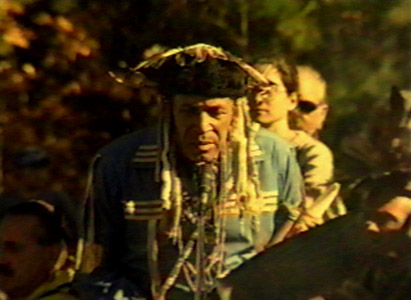
Wampanoag indians |
The Wampanoags were sometimes referred to as Pokanokets, in reference to the sachemdom or territory centered at Sowams (now Warren, Rhode Island). Pokanoket means "Place of the Clear Land," and Wampanoag means "People of the East." At the beginning of the seventeenth century between twenty-one and twenty-four thousand Wampanoags inhabited the southeastern portion of present-day Massachusetts, Martha's Vineyard, the Elizabeth Islands, Nantucket, and the eastern part of Rhode Island. Their grand sachem was Massasoit, who had authority over all the Wampanoag sachemdoms. Wampanoag men built their people's circular homes, engaged in politics, traded, hunted, and fought. Women cultivated the land, caught shellfish, cooked, cared for children, and manufactured mats, baskets, and clothing. The Wampanoags were competent farmers, fishers, hunters, and gatherers, and performed their tasks according to a seasonal schedule. Today there are two bands of Wampanoags—one in Mashpee, Massachusetts, and the other on Martha's Vineyard.
Hunters were living on Martha's Vineyard as early as 2270 B.C. The direct ancestors of today's Gay Head Wampanoags were firmly established on Martha's Vineyard by A.D. 1380. In 1641, Thomas Mayhew purchased Martha's Vineyard, Nantucket, and the Elizabeth Islands from the British for forty pounds. According to the first English settlers, the Martha's Vineyard Wampanoags numbered about 3,000 in 1602 and about 2,500 in 1674. Because of a host of deadly diseases brought by the white newcomers and the overwhelming pressure to conform to a society so alien to their traditional values, the Martha's Vineyard Wampanoags today number only about 700; of these, some 250 live on the island. In 1870 the main Indian settlement on the island, centered at Gay Head, was officially given town status by the state of Massachusetts. This action took away all of the community's Indian rights and facilitated the destruction of its culture and lifestyle. In 1987, the Gay Head Wampanoags were granted federal tribal status. The Gay Head Wampanoags believe that the giant Moshup created Martha's Vineyard and its neighboring island, taught their people how to fish and to catch whales, and still presides over their destinies. They also believe that a hundred million years of history are imprinted in the Gay Head cliffs. Cranberry Day (the second Tuesday in October), though no longer a festival lasting three or four days, is still more important and meaningful to the Gay Head Wampanoags than any other holiday, including Christmas. Moshup Pageant (in August) honors and reenacts the story of Moshup's life until his disappearance, weaving together narration, music, and drama. Though regaining Wampanoag sovereignty over all of Gay Head is a goal yet to be fulfilled, the Gay Head Wampanoags have recovered a measure of self-government over their daily affairs, especially as regards health services, scholarship programs, and local environmental policies. The tribal council, consisting of a chairperson and twelve council members, is elected by the Gay Head Wampanoags to represent them in all affairs pertaining to the tribe. The Gay Head Wampanoags also have a multipurpose building that houses various offices and provides a place where they can gather for council meetings (twice a month) and general membership meetings (four times a year). During the nineteenth century, a whole social fabric, and the traditions that supported it, were obliterated by the dominant American culture. Of the Wampanoag language, little has survived. Nonetheless, a hopeful trend is rising today, together with a new determination to preserve what is left of the Wampanoag legacy and pass it along to following generations. Though the Gay Head Wampanoags do not have their own schools, school curricula and activities are being progressively redesigned so as to make room for the teaching of native history and culture. Wampanoag women's groups have been formed to revive the traditional gathering of foods and medicinal herbs and to preserve Gay Head Wampanoag arts and crafts. |