 STATUS: Endangered
Chimpanzee facts |
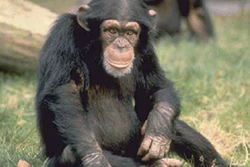
DESCRIPTION: Chimpanzee faces are pinkish to black, and the apes' bodies are covered with long black hair. Chimps lack a tail. Their opposable thumbs and toes help them grasp objects easily. Chimpanzees are quadrupedal, which means that they walk on all four limbs, although they can also walk upright (bipedal) for short distances. SIZE: Standing approximately 4 feet high, males weigh between 90 and 120 pounds, while females weigh between 60 and 110 pounds. POPULATION: An estimated 100,000 to 200,000 chimpanzees remain in the wild. LIFESPAN: Chimpanzees rarely live past the age of 50 in the wild, but have been known to reach the age of 60 in captivity. RANGE: Chimpanzees can be found in 21 African countries. HABITAT: Chimps prefer dense tropical rainforests but can also be found in secondary-growth forests, woodlands, bamboo forests, swamps, and even open savannah. FOOD: Chimpanzees are omnivores, meaning they eat a wide variety of foods that includes fruits, nuts, seeds, and insects. Chimps occasionally hunt and eat meat. BEHAVIOR: Chimps live in communities. These communities are composed of family groups of three to six individuals, totaling about 50 animals. Hierarchies are formed by the adult males of the community, which is led by one alpha (the highest) male. Adolescent females may move freely between communities, although territory is strictly patrolled and conflicts can occur between neighbors. OFFSPRING: Most mothers give birth to one young an average of every five to six years in the wild. Young chimps stay with their mothers for up to 10 years. THREATS: Habitat destruction is the greatest threat of the chimpanzee. Large population decreases are also blamed on hunting and commercial exportation.Two species of chimpanzee occur in Africa: the inappropriately named Common Chimpanzee Pan troglodytes (often shortened to Chimpanzee, and sometimes referred to as the Robust Chimpanzee) and the Bonobo Pan paniscus (formerly known as the Pygmy or Dwarf Chimpanzee, and sometimes referred to as the Gracile Chimpanzee). There is significant overlap in size between the Chimpanzee and the Bonobo, but the latter is more gracile in build, with a smaller, rounder skull, and a flatter face with less-prominent brow ridges. Both species are highly social animals, and can exist in large groups; bonobo communities contrast with chimpanzees' in that females are dominant and maintain strong bonds with other females. The Chimpanzee has a wide but discontinuous distribution in Equatorial Africa, in about 21 countries from Senegal in the west to Tanzania in the east (it is difficult to be precise because chimpanzees have become extinct in 4-5 countries in recent years). Most taxonomists have recognised three or four distinct subspecies, although current genetic studies appear likely to refine this picture significantly. The western subspecies, P. t. verus, once occurred in 10-12 countries from southern Senegal east to the Niger River in central Nigeria, but the range has greatly diminished. Populations between the Niger River in Nigeria and the Sanaga River in Cameroon have recently been described as a separate (fourth) subspecies, the East Nigeria-West Cameroon Chimpanzee P. t. vellerosus. The central subspecies, P. t. troglodytes, occurs from north Cameroon to the Ubanghi River and south to the Congo River. The eastern subspecies, P. t. schweinfurthi is found from the confluence of the Ubanghi and Congo rivers in western DR Congo east to the southern end of Lake Tanganyika in Tanzania, and from there northwards to Burundi, Rwanda, Uganda and southern Sudan. Substantial numbers may exist in unsurveyed areas of eastern DR Congo, but elsewhere populations are small and scattered. No formal subspecies are currently recognised within the Bonobo, which is found in only one range state - DR Congo. It has a relatively wide but markedly discontinuous distribution in the central Congo basin, south of the Congo River. It occurs in forests around the Lomami River, the Kasai-Sankuru Rivers, and in the Lake Tumba-Lac Ndombe region, although it appears to be absent from the central part of this area between the Momboyo River and the Busira River. It had been thought that the species' range was continuous within this large forest zone, totalling approximately 350,000 km2, but field observations since the 1970s indicate that it is absent or rare in many areas and common only in a few scattered localities. Studies in the last decade have confirmed viable populations near the towns of Befale, Djolu, Bokungu and Ikela, and in a 3,000 km2 area between the Yekokora and Lomako Rivers It is difficult to assess population size and monitor trends in both species of chimpanzee. Attempts have been made to estimate overall population size by applying population density values at known sites to the remaining area of suitable habitat in the species range. Two such estimates of population size of Common Chimpanzee P. troglodytes made in the late 1980s indicated a total population size of between 145,000 and 230,000. More recent estimates suggest that fewer than 12,000 of the western subspecies remain (with the largest population in Côte d'Ivoire), possibly 80,000 of the central group, and some 13,000 of the eastern subspecies. These would make up a total species population of around 105,000 (not including the East Nigeria-West Cameroon subspecies, which is restricted in range and probably low in numbers). The largest remaining populations occur in central Africa, mainly in Gabon, DR Congo and Cameroon. Populations are extremely depleted in five countries (Ghana, Guinea-Bissau, Nigeria, Burundi and Rwanda), and another five countries (Senegal, Mali, the Cabinda enclave of Angola, Equatorial Guinea and Sudan) contain only small and dispersed remnant populations. Chimpanzees are now extinct in four of the 25 countries they once inhabited (Gambia, Burkina Faso, Togo and Benin). It is clear that numbers have declined substantially and populations are almost everywhere at risk. The commercial bushmeat trade is by far the greatest threat to both the Chimpanzee and Bonobo. This is compounded by commercial logging, by conversion of habitat to agriculture, including cash crops and subsistence farming, by mineral prospecting and mining, and forest fires. Progressive habitat loss often leaves small and unconnected patches in which chimp and bonobo populations are isolated and at risk from chance demographic factors. Development of logging or mining operations invariably extends new access routes into undisturbed habitat, with a marked increase in hunting of animals for bushmeat, often followed by conversion for agriculture. Deforestation is far advanced in West Africa, where only remnant tracts of primary rain forest persist. The fragmented populations of the eastern and western subspecies of Common Chimpanzee are primarily located in remnant forest, game reserves and national parks, but unauthorised hunting, logging, mining and farming are common in many nominally protected areas. The Bonobo occurs in Salonga National Park (a World Heritage site), but this area is affected by civil war and increased hunting; elsewhere bonobos occur in a locally managed wildlife sanctuary in the Lukuru area of DR Congo. The status of bonobo populations is unlikely to be known until there is a lasting peace in DR Congo, because currently the front line between opposing factions runs through the centre of the species' range. Hunting of adults for bushmeat has a disproportionate impact on populations because of both species' slow reproductive rate. Bushmeat is often a major source of dietary protein in West and Central Africa, and although ape-meat forms no more than 1-2 per cent of the meat consumed or traded, it may be favoured in some areas for its perceived magical or medicinal benefits. Although subsistence hunting may have once been at sustainable levels, it increases with logging and mining because food is required to maintain large labour forces, because colonising human communities often favour bushmeat, and because modern transport systems enable access to distant urban markets. Civil wars exacerbate the problem because of the increased availability of guns, displacement of people and reduced agricultural output, all of which increase hunting levels. Chimpanzee products are widely sold in local and regional markets, and trade in live infant chimps and bonobos is often associated with hunting of adults. Bonobos appear particularly sensitive to disturbance, and are liable to move away from increasing contact with humans, and are particularly vulnerable to hunting with firearms. The live animal trade, including capture of infants for the pet trade and entertainment industry, and the international biomedical trade, are additional pressures. It has been reported that around 1,000 wild-caught chimpanzees were exported from Africa annually during the past decade. Although much concern has in the past been expressed over such uses and the possible impact on wild populations, in itself this is far less a threat than the killing of adults for bushmeat and progressive habitat loss. Both the Common Chimpanzee and Bonobo are listed on Appendix I of the 1973 Convention on International Trade in Endangered Species of Wild Fauna and Flora (CITES), and trade in individuals or products is therefore subject to strict regulation by ratifying nations. Trade for primarily commercial purposes is banned. Both species are protected by law throughout their ranges, although enforcement is usually poor to non-existent. Both are listed in Class A of the African Convention (1969), which prohibits the hunting or capture of the species unless in the national interest or for scientific purposes. Source: UNEP- World Conservation Monitoring Centre (WCMC)
|