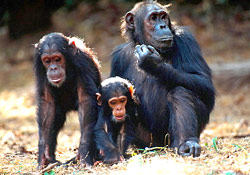
 Chimpanzees, the closest living relative to humans, share an estimated 98 percent of our genes. Four subspecies of chimpanzees are identified, based on differences of appearance and distribution: the western chimpanzee, central chimpanzee, eastern chimpanzee and the Nigeria chimpanzee
Great Apes |
The chimpanzee's characteristic shape includes arms that extend beyond the knees, opposable thumbs and a prominent mouth. The skin on its face, ears, palms, and soles of the feet is bare, and the rest of the body is covered with brown to black hairs. Adults have bare, black faces, and fur color ranging from deep black to brown; young chimps have pinkish ears, nose, hands, and feet. When erect, chimps stand between 3 and 5 1/2 feet tall. In the wild, males can weigh between 75 and 150 pounds, and females between 57 and 110 pounds. Chimpanzees usually move on the ground, although during the day they stay mostly in trees, where they also sleep in makeshift nests made with vegetation. The species walks on all fours, but individuals can also walk on their legs for more than a half-mile, and young individuals sometimes swing from branch to branch. Chimpanzees eat with their hands, which they also use to throw objects at enemies and to create tools. Notably, chimps will poke a stick into a termite mound to feed on the insects and can crack open nuts. Once found in 25 African countries, chimpanzees now are extinct in four and nearing extinction in others due to the terrible toll exacted from deforestation and commercial hunting for bushmeat. All four subspecies of chimpanzee are listed as endangered by the IUCN Red List of Threatened Species. Urgent measures are needed to conserve remaining chimpanzee populations. In West Africa WWF is working to develop and strengthen protected areas in Nigeria and the Ivory Coast. In Central Africa, we are helping establish and manage protected forest areas in Gabon, the Central African Republic, Cameroon and several other countries. WWF is also working to stop the illegal killing of apes in logging areas and to reduce the impact of the bushmeat trade on endangered species such as apes. Range states
|