 Habitat: Equatorial Africa in Cameroon, Equatorial Guinea, Gabon and Congo
Mandrill Baboon |
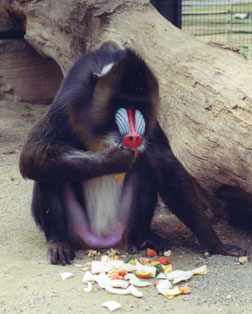
Diet: Omnivorous - Fruits, nuts, other plant material, small animals and insects. Gestation: 7 and 1/2 months. The largest and most colorful of the baboons, the Mandrill is on the endangered species list due to habitat destruction and killing by natives for food (bush meat). The brightly colored buttocks and facial markings of the adult males serve as a guiding beacon to the rest of the troop as they are foraging through the dense jungle foliage. The adult male mandrill is almost twice the size of the adult females and is the only member of the troop that is highly colored. This is called sexual dimorphism, when the male and female of a species are different in size and coloration. Mandrills live in family groups of one adult male, 5 to 10 females and various age offspring. The male vigorously defends his troop against leopards, pythons, etc. The yawning gesture that the male displays is a threat to would-be male rivals or predators, allowing him to display the large canine teeth which he is quite willing to use if necessary. Despite their formidable appearance and reputation for ferocity, mandrills are actually quite gentle and adapt well to captivity. Mandrills have been known to live up to 46 years in zoological parks, which is much longer than they would in the wild. large monkey, Mandrillus sphinx, of central W Africa, related to the baboons . Mandrills are found in forests, while baboons live in open country. The fur of the mandrill is mostly dark brown, but the bare areas—face and buttocks—are patterned in bright colors that are especially spectacular in the adult male, the most colorful of all mammals. The long, heavy doglike muzzle has bright red skin covering the chin, mouth, and nose and extending upward in a narrow strip to the striking, close-set, yellow-brown eyes. The cheeks are bright blue and are folded into an elaborate pattern of ridges. The fur around the eyes is black, and the beard and the edges of the mane are pale yellow. The buttock pads are bright blue, red, and purple. The tail is a short stump. Male mandrills, about 3 ft (90 cm) long, are considerably larger than females and have enormous canine teeth that they display in yawnlike threatening gestures. Mandrills travel on the ground in small family groups, feeding chiefly on insects and vegetation. Powerful animals, and formidable when provoked, they are retiring in habits and avoid contact with humans. They are extremely difficult to observe in the wild. The closely related drill, M. leucophaeus, is also a forest dweller. It is brown with a black face partially outlined in red; the buttock pads are pink. The mandrill and the drill are classified in the phylum Chordata , subphylum Vertebrata, class Mammalia, order Primates, family Cercopithecidae.
|