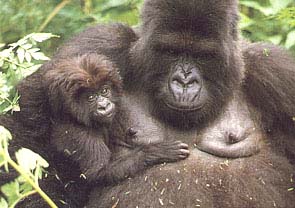
 Scientific Name: Gorilla gorilla
Mountain Gorilla |
Home: Mountain jungles of Zaire, Rwanda, and Uganda Description: Long, silky black coat, massive body with hairless face, palms, soles, and chest Status: The Mountain Gorilla is an endangered species. Fewer than 400 are left in the wild. Poaching and war present the greatest threats to these creatures. The largest of the apes, the Mountain Gorilla is a highly intelligent and gentle creature. Despite a ferocious reputation, the gorilla rarely makes use of his incredible strength. When it comes to defending the family or breeding rights, however, it's full-force fury, gorilla-style. Gorillas spend almost all of their day on the forest floor in small family groups eating leaves and stems of trees, and take a nap at midday. As huge as they are, swinging from branch to branch would be pretty dangerous -- too many branches would break! Young gorillas climb a lot, though. Gorillas don't move around much, and even make their nests right on the ground Geography: The mountain gorilla is found only in central Africa, it is highly endangered its population is restricted to two small isolated enclaves. About 330 mountain gorilla live in the Virunga Volcano region of of Rwanda, Uganda and Zaire. Another 320 mountain gorillas live in the Bwinda Impenetrable Forest in Uganda. In the past these two areas were connected by forest, but as the local human population grew the forests were cut down and the areas are now surrounded and seperated by about 15 miles (24km) of agriculture. Habitat: As their name implies mountain gorillas are found at elevations that range from 7000' to 12000' (2100m to 3650m). Mountain gorillas are found in montane, riverine or bamboo forest zones that are lush and moist and provide an abundance of forage at ground level year round. Food: Mountain gorillas subsist on a wide variety of plants (over 100 species), the bulk of their diet is composed of herbs and vines, augmented by roots, leaves, stems, bamboo, bark, flowers, fungi and occasionally invertebrates (insects, snails and slugs). Population Structure: Mountain gorillas are gentle, intelligent animals that live in highly developed social groups led by a dominant male. These groups range in size from 2 to 35 or more animals, but typically they are composed of 1 silverback male (11+ yrs old), 2 or 3 blackback males (8 to 11 yrs old), 3 to 4 sexually mature females and 3 to 6 juveniles and infants. Gorillas spend their days eating, resting and moving, late in the afternoon the dominant male will pick a site where they will spend the night,each individual (infants up to 3 yrs old sleep with their mother) will construct a nest out of materials readily at hand. The heighth of the nest above ground is inversely related to the weight of the builder, juveniles build theirs the highest, silverbacks the lowest or on the ground. About 5% of the group will also build a nest at the site of their midday rest. Mountain gorillas never sleep in the same nest twice in a row, they occupy a range of 10 to 15 sqmi (26 to 39sqkm). Reproductive Strategy: Mountain gorillas have a very slow reproduction rate, half the young die before reaching sexual maturity. Gorilla groups are cohesive and peaceable, there is little overt dominance among females. Access to breeding females is the perogative of the dominant male. Gorillas breed throughout the year, when a female is receptive she will solicit the attention of the dominant male. The menstrual cycle is 31 to 32 days and the gestation period is 258 days. Newborns weigh about 5 lbs (2.3kg) and while they develop twice as fast as human babies, they are completely dependent on their mother for care . They are carried ventrally by the mother until about 4 months of age, then the infant will ride dorsally, and will be weaned by 2 years old, when they start reaching for and chew on vines and herbs. After giving birth a female will be ready to breed again in 3.5 to 4.5 years.Current Conditions: The mountain gorilla is highly endangered, due to the loss of habitat it population dropped to 250 individuals during the 1960's and 1970's. In 1967 Dian Fossey established the Karisoke Research Center in Rwanda's Parc National des Volcans, it is the only mountain gorilla research site in the world. Now the population is approximately 650 animals, they do not live long in captivity, so they cannot be found in any zoo in the world! They have no natural enemies, attacks by leopards are rare. During much of the last decade poaching of mountain gorillas had been ended. The market for live baby gorillas and gorilla hands and heads, which are prized as trophies has ended. In 1994 the future prospects of the mountain gorilla dook a downturn as a brutal civil war erupted in Rwanda. This has forced upwards of a million Rwanda refuges into the area. Since 1995 there has been a resugence of poaching. Parkland set aside for the mountain gorilla is encroached upon by agriculture, thousands of local farmers live near the gorillas and place little value on them. Snares set for other game often catch gorillas and mutilate or kill them. When the fighting broke out in 1994 the Karisoke reseach center was evacuated, now the anti-poaching patrols have been reestablished and an effort has been made to rid the forest of land mines left over from the fighting. There is also strong political pressure to convert more of the remaining mountain gorilla habitat into farming or commercial use. The Uganda government currently has several plans to save the mountain gorilla, including turning the local subsistence farmers into conservationists, another plan would funnel tourism dollars from the park to the Uganda villagers so that they can financially benefit from the presence of these invaluable animals. References: EMagazine;The Environmental Magazine Sept/Oct 96 Vol 7 issue 5 pg 14Schaller, George B. "The Mountain Gorilla" The University of Chicago Press Schaller, George B. "The Year Of The Gorilla" The University of Chicago Press Tuttle, Russell H. " Apes Of The World" Noyes Publication
|