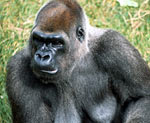
 Starting at age thirteen, the males' backs are covered with silver hair, the source of their name.
Some Facts About Silverback Gorillas |
They can live up to 50 years. These giants—males measure up to 1.7 m (5.6 feet) and weigh up to 200 kg (450 lbs) and females measure up to 70 cm (2.3 feet) and weigh 110 kg (250 lbs)—are introverts who hate conflict. Prolonged stress can cause deep depression that sometimes proves fatal. Attacks by silverbacks are usually due to humans taking the wrong approach. Gorillas do not charge out of aggressiveness but because they haven't been shown the proper respect. Gorillas are vegetarians who include over two hundred different kinds of plants in their daily menu. The dominant male is the head of a harem, but females are allowed to take on a lover as long as the adultery remains discreet. The lovers copulate behind bushes. Females always take the initiative. In the gorilla world, incest is prohibited. The female, who ovulates every thirty days, gestates for eight and a half months before giving birth in a crouching position. She procreates on average every three years and can breast-feed her baby for up to seven years. DNA tests show that gorillas share 98% of human genes. They are closer to us than chimpanzees. With an IQ varying between 85 and 95, gorillas can communicate with us. The proof? This dialogue between Koko, a female gorilla, and American scientist Francine Patterson, who taught the gorilla sign language. The gorilla, the largest of the primates, is a ground-dwelling herbivore that inhabits the forests of central Africa. There are two species of gorilla, both in the genus Gorilla.
Gorillas move about by knuckle-walking. Males range in height from 1.65 m to 1.75 m, and in weight from 140 kg to 165 kg. Females are about half the weight of males. Gestation is 8 ½ months. There are typically 3–4 years between births. Infants stay with their mothers for 3–4 years. Females mature at 10–12 years (earlier in captivity); males 11–13 years, sometimes sooner if they assume leadership early. Lifespan is between 30–50 years. The Philadelphia Zoo's Massa set the longevity record of 54 years at the time of his death. Both species of gorilla are endangered, and have been subject to intense poaching for a long time. Threats to gorilla survival include habitat destruction and the bushmeat trade. A silverback is an adult male gorilla, typically more than 12 years of age and named for the distinctive patch of silver hair on his back, and that has large canines that come with maturity. Blackbacks are sexually immature males of up to 11 years of age.
Silverbacks are the strong, dominant troop leaders. Each typically leads a troop of 5 to 30 gorillas and is the center of the troop's attention, making all the decisions, mediating conflicts, determining the movements of the group, leading the others to feeding sites and taking responsiblity for the safety and well being of the troop. Males will slowly begin to leave their original troop when they are about 11 years old, travelling alone or with a group of other males for 2–5 years before being able to attract females to form a new group and start breeding. While infant gorillas normally stay with their mother for 3–4 years, silverbacks will care for weaned young orphans. If challenged by a younger outside male, he will scream, beat his chest, shake broken-off branches at the intruder, bare his teeth then charge forward. If he is killed by disease, accident, fighting or poachers, the group will split up or be taken over in its entirety by a male descendant or even an unrelated male; there is a strong risk that a new male may kill the infants of the dead silverback. Gorillas are closely related to humans and are considered highly intelligent. A few individuals in captivity have been taught a subset of sign language (see animal language for a discussion) such as Koko, also known for being the only animal known to keep one of another species as a pet. Koko has taken care of several companion cats over the years.
|