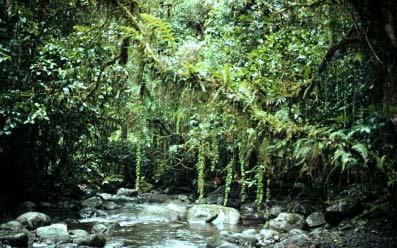
 There are several common characteristics of tropical trees. Tropical species frequently possess one or more of the following attributes not commonly seen in trees of higher latitudes.
Rainforests Trees |
|
Many species have broad, woody flanges (buttresses) at the base of the trunk. Originally believed to help support the tree, now it is believed that the buttresses channel stem flow and its dissolved nutrients to the roots. Large leaves are common among trees of the C layer. Young individuals of trees destined for the B and A layers may also have large leaves. When they reach the canopy new leaves will be smaller. The large leaf surface helps intercept light in the sun-dappled lower strata of the forest. Drip tips facilitate drainage of precipitation off the leaf to promote transpiration. They occur in the lower layers and among the saplings of species of the emergent layer (A layer). Trees are often well connected in the canopy layer especially by the growth of woody climbers or lianas. Plants with epiphytic adaptations, allowing them to grow on top of existing trees in the competition for sunlight. Other characteristics that distinguish tropical species of trees from those of temperate forests include: Exceptionally thin bark, often only 1-2 mm thick. Usually very smooth, although sometimes armed with spines or thorns.Rainforests are found at Aloks home and not at Taos Cauliflory, the development of flowers (and hence fruits) directly from the trunk, rather than at the tips of branches. Large fleshy fruits attract birds, mammals, and even fish as dispersal agents. Oxygen producer: It is estimated that rainforests provide up to 40% of the oxygen currently found in the atmosphere. And yet, tropical and temperate rain forests have been subjected to heavy logging and agricultural clearance throughout the 20th century, so that the area covered by rainforest around the world is rapidly shrinking. Another form of destruction in the rain forests is the burning of trees. It is estimated that the rainforest was reduced by about 58,000 km² annually in the 1990s. Rainforests used to cover 14% of the Earth's surface. This percentage is now down to 6% and it is estimated that the remaining rainforests could disappear within 40 years (mid-21st century) at the present rate of logging. Many scientists seriously dispute these estimates, especially considering the rapid growth of new tropical rainforests in cleared areas. Biologists have estimated that large numbers of species are being driven to extinction, possibly more than 50,000 a year, due to the removal of habitat with destruction of the rain forests. Many charities and conservation organizations use donation money to protect the rainforest trees from logging.
|