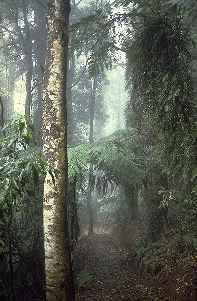
What is Rainforests |
Rainforests are forests which grow in areas of high rainfall. Tropical rainforests are found between the Tropic of Cancer and the Tropic of Capricorn. There are other, temperate rainforests in areas such as the northwest Pacific coast of America. These are much cooler, but experience very high rainfall. Before humans started destroying the rainforests, they covered 15% of the Earth's land area. Today, they cover less than 7% (See map, right for worldwide distribution of rainforests). In the last 200 years, the total area of rainforest has decreased from 7.1 billion acres to less than 3.5 billion acres. More than 30 million acres of tropical forest are destroyed each year, which means at current rates of destruction there will be no rainforest at all in just 40 years. The disappearance of the forest is called DEFORESTATION. As populations have grown and demands for land and timber have grown greater, so the deforestation has accelerated. Asia lost almost a third of its tropical forest cover bettwen 1960 and 1980 - the highest rate of deforestation in the world! In Thailand, 80% of the country's original forest has been cut down in the last 40 years. In the tropics alone, 38 million acres of forest are lost each year. Rainforests are the world's most spectacular ecosystems. An ecosystem is not just the plants, but also the birds, mammals, reptiles, fish, amphibians, invertebrates, bacteria, and even the non-living elements like soil, water and air. In some cases their climates have remained stable for the last 65 million years. This means that they have developed arrays of life unequalled by any other ecosystems on the planet. The destruction of the rainforests will affect other ecosystems throughout the world. Climate During heavy downpours, the mass of vegetation in the rainforest catches and holds much of the rain, then 'disposes' of it through evaporation and transpiration; it breaks the force of the rain and protects the ground surface. Where trees are cut down in large numbers, this natural protection is removed, soil erosion increases and minerals are washed away. Trees also help to control the amount of water that is held in the soil. In areas around the world where forests have been felled, the rainfall patterns have changed. In some places, the rains have almost stopped falling, and in others, flooding has been caused.
|