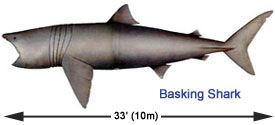
Basking shark |
The basking shark is the second largest fish in the world, second only to another filter feeder, the whale shark. This animal can attain lengths of at least 10 meters (33 feet), but the average size is 7-9 meters. They can weigh up to 4 tons. The shape of its snout is conical and the gill slits extend around the top and bottom of its head. Associated with the gills are structures called gill rakers. These gill rakers are dark and bristle like and are used to catch plankton as water filters through the mouth and over the gills. The basking shark is usually grayish-brown in colour and often seems to have a mottled appearance. The caudal (tail) fin has a strong lateral keel and a crescent shape. The teeth in the basking shark are very small and numerous and often number one hundred per row. The teeth themselves have a single conical cusp, are curved backwards and are the same on both the upper and lower jaws. Diet: Basking sharks are planktonic feeders. By swimming with their mouths wide open, they filter plankton out of the water with their long, tightly set gill rakers. The water then exits the body via the gill slits. Most of the plankton which is ingested consists of copepods and other crustaceans, fish eggs and larvae. The gill rakers are shed in the winter and are replaced the following spring. Swimming: Basking sharks are slow swimmers, going no more than 3 mph (5 kph). They swim by moving their entire bodies from side to side (not just their tails, like some other sharks do). Reproduction: Not much is known about the reproductive biology of the basking shark. They are believed to be ovoviviparous, giving birth to live pups. The young are generally 1.5 to 1.7 meters (5 to 5.6 feet) long. Females reach sexual maturity when they are between 4 to 5 meters (13.2 to 16.5 feet) long. Habitat: The basking shark is a pelagic animal, occurring in warm coastal and cool temperate waters, but often straying inshore. It is commonly seen very near the surface of the water along the coast of Nova Scotia and New Brunswick. During the winter these animals migrate to deep water. Some may overwinter in the deeper waters of the Gulf of St. Lawrence. They spend most of their time at the surface, hence their nickname the "sun fish." Range: The basking shark ranges throughout the north and south Atlantic Ocean, the Mediterranean Sea, north and south Pacific Ocean, the Sea of Japan, off southern Australia and around New Zealand.
|