Blue Shark |
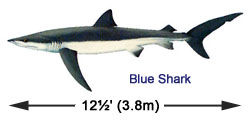
Ecology: Blue sharks inhabit all the temperate and subtropical seas of the world They are abundant in both near shore and open-ocean waters and may be the most common of all the pelagic sharks. In the eastern Pacific they are found from the Gulf of Alaska to Chile. The sharks occur from the surface to at least 152 m depth. Although mostly an offshore species, they may venture inshore especially at night and in areas with a narrow continental shelf. In the northern part of their range, blue sharks are found nearer the surface and in the southern part, at greater depths, preferring temperatures between 45° and 65° F. Life History Reproduction: Blue sharks are viviparous, with the embryos having a well-developed yolk sac placenta attached to the uterine wall of the mother and giving birth to fully developed young. Brood size can vary from 4 to 135 young depending on the females size and condition, with 20 - 40 young being typical. The release of young and their early development apparently occur in oceanic areas. Little is known of this period of their life history. Males mature at about 4 - 5 years of age. Females have an adolescent stage at about 4 - 5 years and are adults from 5 - 6 years of age. Females become sexually active at 5 years and will mate, but will store the sperm and fertilize their eggs a year later. Gestation is 9 - 12 months. Young are born in spring to early summer when the female is 7 years old. Maximum age of blue sharks is unknown, but may be 20 years. Food and Growth: Blue sharks are opportunistic feeders on small pelagic fish and squid, though bottom fishes and invertebrates, small sharks, mammalian carrion, and sea birds are occasionally taken. Feeding is probably done throughout the day, but increased feeding activity at night has been reported. Blue sharks reach a maximum size of 380-390 cm, but are rarely of 260 cm in the NE Pacific. Males mature between 180-280 cm. Females become gravid between 170-220 cm. Size at birth is approximately 35-45 cm. Average growth rate for blue sharks between 80 and 200 cm is about 21 cm/yr (off California). Growth rates of blue sharks off California may be less than those found in the eastern North Atlantic and mean size appears to decrease to the north of their range. The largest blue shark ever taken weighed about 181 kg. Length/weight equations have been developed. Migration: Tagging studies in the Atlantic show blue sharks to be highly migratory. In the north Pacific seasonal migrations occur between 20° and 50° N latitude. As waters warm in the summer months, a northward migration extends into the Gulf of Alaska, reversing southward during winter. The migrations may be reproductive in nature and follow the advance and retreat of a transition zone between major ocean currents. In Monterey Bay, CA, blue sharks become more common as sea surface temperatures increase during late summer and early fall, correlated with sea surface temperatures between 57° and 63° F. Population: At birth, the sex ratio is basically 1:1. As blue sharks mature, there is considerable sexual segregation in populations, with females more abundant at higher latitudes than males. Unisexual schools form in the summer and autumn, and assembly of mixed schools takes place in the winter. Most blue sharks that migrate to Monterey Bay, CA during the late summer and early fall are immature females. Mature adults are uncommon in coastal waters. There are no local or Pacific-wide estimates of stocks or abundance. Sharks tagged off California and recovered near Midway Island (central Pacific) suggesting the local stock is not a closed population. Harvest: A small amount of blue shark has been landed (50-350 lb) in Oregon in the last few years as by-catch from trawl, longline, and troll gear (Table 1.). In California, blue sharks were captured during the development of the drift gill net fishery for swordfish and thresher shark. However, blue shark must be bled, dressed, and cooled down quickly, otherwise the urea within the tissue begins to change to ammonia rendering the meat unpalatable. Therefore, the meat quality of blue shark harvested by gill nets was poor. Changes in season length, fleet size, time-area closures , and the use of large mesh nets substantially reduced by-catch of blue shark in California. Meat quality of catches by longline gear has been high enough where some markets have been developed. The recreational catch of blue shark has grown considerably in recent years in California. Present Regulations: Oregon has no regulations regarding blue shark specifically. It is illegal to use gill nets in state waters without an experimental gear permit. In the past, the PFMC has issued experimental permits to use gill nets in other fisheries when it was demonstrated the incidental catch of other groundfish would be minimal. Incidental catches of other animals (mammals, turtles) is still a concern. It is legal to harvest blue shark in Oregon with longline gear. Suggestions For Future Management: Blue sharks attain large sizes, have gradual growth rates, long life spans, and relative low fecundities. It is quite possible this combination of life-history traits could make this species susceptible to overfishing. Since blue sharks are found world wide, a fishery off Oregon area will probably not have a big impact on the total stock, however, depletion of local stocks may have effects on other resources. There is essentially no information, biological or stock, concerning blue sharks off Oregon. It is possible, a large part of the population off Oregon is immature females. Gill nets may not be suitable gear for harvesting blue sharks. However, if used, incidental catches of other animals will need to be monitored. During the thresher shark gill net fishery off Oregon in 1986-88, few salmon or birds were caught as incidental catch. However, some marine mammals were caught and the incidental catch of turtles was larger than expected. Effects Evaluation: Information is not sufficient to meet state-wide planning Goal 19. Additional information is needed to determine short-term and long-term effects of harvesting blue sharks on resources and uses of other marine resources, the continental shelf, the Oregon nearshore ocean, and onshore areas. Blue sharks should be managed under the developing fisheries program with conservative numbers of permits and restrictions. (1) Sustainability of developmental fisheries resources or incidental catch under proposed future harvest;
(2) Biological and ecological effects on critical marine habitats, other habitats and other species supported by those habitats;
(3) Conformity and compatibility with existing uses such as commercial and recreational fishing, non-consumptive uses, public access, etc;
(4) Ability of the Department and other agencies to monitor the fishery for needed data and compliance with rules and regulations;
(5) Recommendations for future fishery development including gear types and effort levels;
Program Objectives (1) Develop scientific information on the stocks and life history of blue shark.
(2) Develop understanding of effects of harvest on marine ecosystem.
(3) Develop improved fishing practices and equipment to protect the ocean resources.
(4) Identify and protect critical marine habitat and other important biological habitats for blue shark.
(5) Report findings and research data during annual review. References: Cailliet, G. M. and D. W. Bedford. 1983. The biology of three pelagic sharks from California waters, and their emerging fisheries: a review. CalCOFI Rept. 24:57-69. Cailliet, G. M., L. K. Martin, J. T. Harvey, D. Kusher and B. A. Welden. 1983. Preliminary studies on the age and growth of blue, Prionace glauca, common thresher, Alopias vulpinus, and shortfin mako, Isurus oxyrinchus, sharks from California waters. pp. 179-188. In E. D. Prince, and L. M. Pulos (eds). Proceedings of the international workshop on age determination of oceanic pelagic fishes: Tunas, billfishes, and sharks. NOAA Tech. Rept. NMFS 8, Compagno, L. J. 1984. Sharks of the world. An annotated and illustrated catalogue of shark species known to date. Part 2. FAO Species Synopsis, No. 125 (4):251-655. Hanan, D. A., D. B. Holts and J. A.L. Coan. 1993. The California drift gill net fishery for sharks and swordfish, 1981-82 through 1990-91. California Department of Fish and Game, Fish Bulletin 175. :95 pp. Harvey, J. T. 1989. Food habits, seasonal abundance, size, and sex of the blue shark, Prionace glauca, in Monterey Bay, California. Calif. Fish Game. 75(1):33-44. Holts. 1992. Blue shark. pp. 53-54. In W. S. Leet, C. M. Dewees, and C. W. Haugen (eds). California's living marine resources and their utilization. Sea Grant Extension Publication UCSGEP-92-12, Pratt, H. L. 1978. Reproduction in the blue shark, Prionace glauca. Fish. Bull. 77(2):445-470. Strasburg, D. W. 1958. Distribution, abundance, and habits of pelagic sharks in the central Pacific ocean. Fishery Bulletin 138. 58:335-361. |