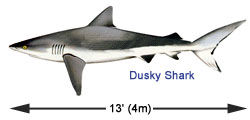
Dusky Shark |
Distribution Dusky whalers inhabit all Australian continental shelf waters as far south as Hobart.2 Elsewhere, dusky whalers are present in the eastern Pacific Ocean, the western Atlantic and eastern Atlantic oceans, western Indian Ocean and some regions of the western Pacific.1 Bronze whalers inhabit warm-temperate1 coastal waters in Australia, from Coffs Harbour in northern New South Wales, along southern Australia to Jurien Bay in Western Australia.2 Reports of the species off eastern Tasmania are unconfirmed. They have a similar global distribution to dusky whalers, except that they are also present in New Zealand. Dusky whalers and bronze whalers are generally common in offshore waters of the continental shelf. Both species occasionally enter large coastal bays and inshore areas, as far inshore as the surf line. Dusky whalers inhabit waters from the surface to a depth of 400 m,1 and bronze whalers range from the surface to a depth of at least 100 m.2 Bronze whalers sometimes enter estuaries, but dusky whalers tend to avoid estuaries and areas of reduced salinities.1 Life history These sharks are viviparous, ie they produce live young. A dusky whaler litter contains 3–14 pups,2 possibly more, born at about 70–100 cm total length. The number of pups in a bronze whaler litter varies from 7 to 20,2 and they are born when 59–70 cm long.1 In both species, birth may occur at any time of year, but with a peak in summer. Gravid females of both species move inshore during spring to drop their young.1 A known pupping site for bronze whalers is just north of Adelaide in Gulf St Vincent. Dusky whalers reach a maximum size of about 370 cm total length. The largest recorded in Australia weighed 323.5 kg and measured 345 cm total length.2 Adult dusky whalers mature between 14 and 18 years3 when about 280 cm total length1,2 and live at least 35 years.3 Bronze whalers are recorded to reach a maximum size of 295 cm total length2 and a maximum age of 30 years (males) and 25 years (females).4 The largest recorded individual caught in Australia weighed almost 227 kg and measured 295 cm total length.5 Preliminary calculations of bronze whalers' ages at first sexual maturity are 13 years (males) and 19 years (females).4 Dusky whalers and probably also bronze whalers migrate, following the warmer water southwards in the spring and summer and northwards in the autumn and winter. There are records of dusky whalers migrating long distances in Western Australia: from the region between Augusta and Shark Bay, they have migrated to as far away as Rowley Shoals off the north-west coast and Esperance on the south-east coast.6 Dusky whalers may also migrate in groups of the same sex and similar age class.1 In Western Australia and South Australia both species are common inshore only during summer and autumn. Seasonal, inshore–offshore movements also occur — especially by pregnant females moving from outer continental shelf regions onto the inner shelf to pup, and returning. Immature sharks, usually less than 150 cm total length, may remain resident in nursery areas, independent of season, until they reach a size where temperature-related migration occurs.1 Bronze whalers feed on a variety of bony fishes, including pilchards (Sardinops neopilchardus), trevallies (Carangidae), mullet (Mugilidae), spiny dogfish (Squalus species), squid and cuttlefish (Sepia species).1 Young dusky whalers form large feeding schools or aggregations. Dusky whalers eat a variety of bony fishes from reefs, the sea floor and pelagic zones. Both species commonly eat eagle rays (Myliobatis australis) in southern Australian waters, and 'packs' of 20–30 large individuals (about 2 m long) have been observed preying heavily on schools of pilchards and Australian salmon (Arripis truttaceus) off South Australian beaches in summer (eg Sceale Bay, Anxious Bay, Avoid Bay),7 and schools of tailor (Pomatomus saltator) off New South Wales beaches. Young dusky whalers are preyed upon by other large sharks such as white pointers (Carcharodon carcharias) and tiger sharks (Galeocerdo cuvier). Stock structure There is no information on stock structure of either species in Australian waters, although their migratory behaviour suggests they each comprise a single stock. Commercial fishery The major commercial fishery for dusky whaler and bronze whaler is in Western Australia. A smaller fishery exists in South Australia. The Western Australian shark fishery is based in temperate waters from the Western Australian–South Australian border to south of Shark Bay (about 27° S). Most fishing is carried out off the south and south-west coasts to depths of about 80–100 m.6,8 The fishery consistently catches about 25 species of shark,6 of which the most important are dusky whaler, gummy shark (Mustelus antarcticus), whiskery shark (Furgaleus macki), sandbar shark (Carcharhinus plumbeus) and wobbegong shark (Orectolobidae). Bronze whalers are confused with dusky whalers in catch records but comprise only about 5 % of the 'dusky whaler' catch, which makes up about 29 % of the entire shark catch in the south-west of Western Australia.2,8 Dusky whalers are caught mainly between the Albany and Busselton regions of the fishery. The sharks are caught mainly with bottom set gillnets several km long, and a small proportion are caught on bottom set longlines of several hundred hooks. Dusky whalers and bronze whalers are also caught on droplines and handlines. Fishing effort in the southwest shark fishery in Western Australia has been increasing since about 1976–80. Fishing effort increased by 274 % from 1980–81 to 1987–88.6 Catch rates fell during this period but they stabilised in 1987–88, and remain so. The fishery has developed rapidly over the last 5 years. These whalers also comprise an incidental catch of demersal otter trawling off southern Australia. Dusky whalers and bronze whalers are primarily exploited as newly born and small juveniles of around 100 cm total length, in what are probably their nursery areas.2,6 Hence, annual catch variations are likely to be related to the number of new recruits available to the fisheries in any one year.6,8 Bycatches of the dusky and bronze whaler fishery other than sharks include large quantities of scale fish, such as queen snapper (Nemadactylus valenciennesi), snapper (Pagrus auratus), silver trevally (Pseudocaranx dentex), ocean jacket (Nelusetta ayraudi) and redfish (Centroberyx species).6 In the South Australian inshore fishery, both species are targeted in Gulf St Vincent and Spencer Gulf, off the Murray River mouth, the south-east coast and South Australian west coast bays. The catch mainly comprises juveniles of less than 150 cm total length. The whalers are caught with large mesh bottom set gillnets and bottom set longlines. Half of the catch comes from inshore waters, primarily the west coast bays. Dusky whalers and bronze whalers are sold on domestic markets for their flesh in the 'fish-and-chip' trade. In 1991–92 in Perth markets, fishers received A$ 4.00–5.00 per kg for whalers. Management controls Management steps introduced by the Western Australian Government on the Southwest Shark Fishery include restricted access, gear limitations, transfer of licences and introduction of a system of time-gear access units which control the number of nets and the period of time they may be used over a year. In South Australia there are limits on the number of hooks on longlines and on entry to the fishery. Recreational fishery Whaler sharks are frequently targeted by gamefishers. Moderately heavy lines with wire or light chain traces, and gamefishing tackle are used, often off jetties (such as at Giles Point, Rapid Bay and Port Noarlunga in South Australia, and Lorne and Point Lonsdale in Victoria). Often the sharks are first attracted by burley and then presented with large chunks of fish such as tuna. Much 'blind' (untargeted) fishing takes place with surf fishing tackle on long beaches such as Nintey Mile Beach in Victoria and Younghusband Peninsula in South Australia, where mulloway (Argyrosomus hololepidotus) and Australian salmon are the principal target species. Dusky and bronze whalers are not targeted by anglers in Western Australia. Dusky whalers comprise about 5 % of all sharks caught by New South Wales gamefishing clubs between Port Macquarie and Sydney, and sharks in this group (Carcharhinidae) comprise only 24 % of all sharks caught.9 Management controls There are no controls on recreational fishing. Resource status The fisheries in Western Australia and South Australia are based on juveniles, probably in nursery areas. The extent of the nursery areas is not known and little is known of the extent of exploitation of adults. If the sharks' migratory behaviour means that stocks are not being fished over the extent of their Australian distribution, then current levels of fishing may be sustainable.6 However, it is known that the relative abundance of juveniles in Western Australia is about 25 % of the unfished population.10 Whalers, in common with other shark species, have low fecundity, a late age of sexual maturity, slow growth rates and a long gestation period. Any indications of overfishing could take many years to show, and any corrective management even longer to take effect.6 References 1. Compagno, L.J.V. (1984). FAO species catalogue, vol. 4. Sharks of the world. An annotated and illustrated catalogue of the shark species known to date. Part 2 — Carcharhiniformes. FAO Fisheries Synopsis No. 125 4(2): 251–655. 2. Last, P.L. and Stevens, J.D. (in press) Sharks and rays of Australia. Melbourne: CSIRO. 3. Natanson, L.J. (1990) Relationship of vertebral band deposition to age and growth in the dusky shark, Carcharhinus obscurus, and the little skate, Raja erinacea. Unpublished PhD thesis, University of Rhode Island. 4. Walter, J.P. and Ebert, D.A. (1991) Preliminary estimates of age of the bronze whaler Carcharhinus brachyurus (Chondrichthyes: Carcharhinidae) from southern Africa, with a review of some life history parameters. South African Journal of Marine Science 10: 37–44. 5. Hutchins, B. and Swainston, R. (1986) Sea fishes of southern Australia. Complete field guide for anglers and divers. Perth: Swainston Publishing. 180 pp. 6. Lenanton, R., Millington, P. and Smyth, C. (1989) Shark and chips. Research and management into southern WA's edible shark fishery. Western Fisheries May/June: 17–23. 7. Cappo, M. (in press) How many species of whaler sharks in South Australia? SA Angler. 8. Heald, D.I. (1987) The commercial shark fishery in temperate waters of Western Australia. Fisheries Department of Western Australia Report 75. 71 pp. 9. Pepperell, J.G. (1992) Trends in the distribution, species composition and size of sharks caught by gamefish anglers off south-eastern Australia, 1961–90. Australian Journal of Marine and Freshwater Research 43: (in press) 10. Hall, D.A. (1991) A discussion of options for effort reduction. Report, Southern Demersal Gillnet and Demersal Longline Fishery Management Advisory Committee. Fisheries Department of Western Australia Fisheries Management Paper 43. 6 pp
|