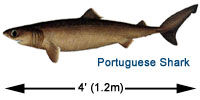
Portuguese Shark |
|
| The Portuguese shark has a stout body with two small dorsal fins that have inconspicuous spines at their origins. The second dorsal fin is larger than the first although they are both relatively small in comparison to the size of the shark. The upper teeth of this shark are long, pointed and have a smooth edge. The teeth in the lower jaw are short and broad. The colouration of this species varies with the age of the individual. Adults are brown while individuals that are half grown are black, and juveniles are dark blue. This shark reaches a maximum size of 1.2 meters (4 feet). Dermal denticles in the young and juveniles have three points and are widely spaced, while adults have dermal denticles that are large, scale-like and closely overlapped.
Diet: The diet of the Portuguese shark consists of squid and bottom dwelling fishes. Marine mammal skin and muscle have also been found in stomachs, but it is not clear if mammals are part of their regular diet. Reproduction: Development in this shark is ovovivparous and litters are usually 13 to 16 pups. When the young are born they are generally 27 to 30 cm (11 to 12 inches) in length. Habitat: This shark lives in very deep waters with most captures being at depths greater than 910 meters (3000 feet). However they have also been caught at depths of 2700 meters (8920 feet). The temperature of water in which these sharks are found is between 5 and 6 degrees Celsius. Range: The Portuguese shark is present in both the western and eastern North Atlantic. It also occurs in the western Mediterranean, in Japanese waters and in the Pacific off New Zealand. In the western North Atlantic this shark ranges from the Grand Banks to Delaware Bay. There are reports that the Portuguese shark occurs on the Scotian Shelf (specifically Banquereau Bank) and Georges Bank. |