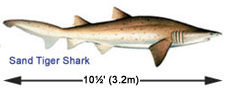
 Physical Characteristics: Sand tigers are large sharks with a stout, bulky, fusiform body (tapered at both ends), an upturned, short, pointed, flattened snout, and three rows of long needle-like front teeth that protrude from their open mouth and molar-like back teeth. Their two dorsal fins and anal fins are similar in size.They do not have a nictitating membrane (extra eyelid) with which to protect their eyes during feeding or attacks as many other sharks do.
Sand Tiger Shark |
Size and Weight: Males average 2.2-2.6 m (7-8.5 ft) in length and females females 2.3-3.0 m (7-9.8 ft. These sharks have been known to reach a length of 3.2 m (10.5 ft) and a weight of 159 kg (350 lb). Diet and Feeding: These voracious sharks consume large and small bony fishes, small sharks, rays, crabs, lobsters, and squid. They feed cooperatively with other sand tiger sharks, surrounding, and herding schooling prey. Reproduction: Sand tiger sharks are ovoviviparous (incubate eggs internally and offspring are born live). Females have two uterine chambers where 16-23 eggs each are fertilized internally. Early in development the embryos receive their nourishment from their egg yolk. When they are about 10 cm (4 in) in length, the yolk is exhausted. At the same time the mouth of the embyro becomes functional and teeth are formed. Eggs hatch in the uterine chamber when the embryos are about 17 cm (6.7 in) in length. The largest and most advanced embryo in each chamber (usually the first hatched) kills and consumes younger developing siblings (intrauterine cannibalism). After preying on their siblings, the two remaining embryos feed on any eggs present. Eventually, two pups are born, one from each uterine chamber. Pups are 95-105 cm (37-41 in) long at birth. Behavior:Sand tigers are strong but slow moving relatively sluggish sharks that spend most of their time near the bottom looking for food. They swim to the surface of the water to gulp and swallow air, retaining it in their stomach to create near neutral buoyancy that allows them to remain virtually motionless above the ocean floor. They are the only known shark to do this. Adaptations:Like most sharks, sand tigers are able to detect electrical signals emitted by potential prey in the water column or substrate with specialized electrosensory organs on the sides of their head and lower jaw called ampullae of Lorenzini. They also have acute senses of smell, touch, and hearing. They have good vision, are very sensitive to low-light conditions, and are able to discriminate between light and dark objects. Their adaptations of electrical reception, smell, and hearing combine to make them efficient and feared predators. Longevity: These sharks are known to live as long as 10 years in a protected environment. There has been a report of one shark that lived to be 16 years old. Life span in the wild is unknown. Conservation: Sand tiger sharks are listed as endangered on the IUCN Red List. Fished commercially in all areas of their range, they are being pushed to commercial extinction because of overfishing. Their predictable habits, schooling, and low reproduction rates have all contributed to their serious population reduction. Sand tiger sharks are protected in the United States, Australia, and New Guinea.
|