Hammerhead Shark |
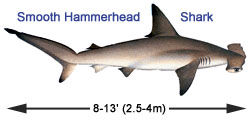
The Hammerhead shark (genus Sphyrna) is a member of the family Sphyrnidae. The only other genus of Sphyrnidae, Eusphyra, contains only one species, E. blochii, the Winghead Shark). The eight species of hammerhead range from 2–6 m long, and all species have projections on both sides of the head that give it a resemblance to a flattened hammer. The shark's eyes and nostrils are at the tips of the extensions. It is an aggressive predator that eats fish, rays and other sharks, cephalopods, and crustaceans. It is found in warmer waters along coastlines and continental shelves. The shape of the head seems to act as a wing, aiding in close-quarters maneuverability. It also seems to help in electrolocation by separating the receptors, allowing signals to be received as though in stereo. These sharks have been able to detect an electronic signal of one billionth of a volt. Hammerheads have proportionately small mouths and seem to do a lot of bottom-hunting. They are also known to school, sometimes in groups of over a hundred. Of the eight species of hammerhead, three can be dangerous to humans—the scalloped, great and smooth hammerheads. hammerhead shark, active, surface-living shark, genus Sphyrina. Its curious head has lateral projections resembling the crossbar of a T, and its eyes and ears are located in the outer tips of the projections. It has been suggested that the extension of the head in the plane of the pectoral fins may give the fish increased lift, but there is no evidence that hammerheads are better swimmers than other sharks. Found in inshore, brackish water, hammerheads are both predators and scavengers. They feed on a variety of fishes including skates, rays, and other hammerheads, and large hammerheads have been known to attack and eat humans without provocation. The largest species is the widely distributed great hammerhead, Sphyrina mokarran, which typically reaches 15 ft (4.6 m) in length; the distance between its eyes may be as much as 3 ft (90 cm). The common hammerhead, S. zygaena, is found in all tropical waters, summering as far N as Newfoundland. It may reach a length of 12 ft (3.7 m). The bonnet, or shovelhead, shark is a small, harmless hammerhead found in the W Atlantic from Brazil to Massachusetts. It reaches a length of 5 ft (150 cm) and its lateral lobes are much shorter than in other species, giving the head a rounded appearance. There are several other species distributed throughout tropical and temperate oceans. Hammerhead sharks are classified in the phylum Chordata, subphylum Vertebrata, class Chondrichthyes, order Selachii, family Sphyrnidae.
|