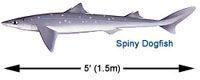
 Description: This shark species is mainly caught as bycatch in several deepwater trawl fisheries, and by inshore trawlers, set netters and longliners. Description: This shark species is mainly caught as bycatch in several deepwater trawl fisheries, and by inshore trawlers, set netters and longliners.
The main concerns with this fishery are: absence of catch limits for all areas, the unknown sustainability of current catch limits and the absence of quantitative stock assessment, the uncertainty about stock boundaries, the impact of trawling on benthic habitat, and the absence of a management plan.
The fishery assessment plenary report states: "…It is unknown whether the catch limits which are greater than recent catch levels are sustainable or whether they are at levels which would allow the stock to move towards a size that will support the maximum sustainable yield." (Ministry of Fisheries, 1998, p377).
Market: New Zealand
Status and sustainable yield
Status:Uncertain.
Annual catch limit: There is no catch limit for all areas.
Recorded catch: Reported landings of 11,530 tonnes in 2001-02, steadily up from estimated catches in the low thousands of tonnes during the early 1980s.
Population size: An increase in biomass is suggested for 1991-1998.
Stock trends: There was an upward trend in reported catches between 1980-81 and 2001-02.
Fishing method
Method: Trawling.
Habitat damage: Impact of trawling on bottom dwelling species and habitat.
Bycatch: Mainly bycatch in a range of trawl fisheries including hoki, barracouta and red cod.
Ecological effects: This may be one species benefiting from over-fishing of middle-depth and deepwater species.
Management
Stock assessment: No quantitative stock assessment.
Management plan: No.
Quota management species: No.
Biology
Distribution: Most common off the south and east coasts of the South Island at depths of 100-700m, but also occurs on the Chatham Rise and northern Campbell Plateau.
Maximum age (years): 21-26
Age at sexual maturity: 6-10
Growth rate: Moderate.
Reproductive output: Medium.
Age exploited: 4 (uncertain)
References: Report from the Fishery Assessment Plenary, May 1998: stock assessments and yield estimates. Part 2: Orange roughy to Yellow-eyed Mullet. Annala et al, Science Group, Ministry of Fisheries; Guidebook to New Zealand Commercial Fish Species, Revised Edition 1990, NZ Fishing Industry Board.
|