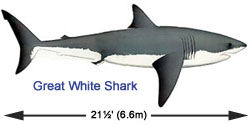
 The white shark is also commonly known as the great white shark. It is a solitary predator that can grow up to 6.6 meters (21 feet) in length. Although this is the largest confirmed report of a white shark, indirect evidence suggests that there may be specimens off of southern Australia which are 8 meters (26 feet) in length.
The great white shark |
Diet: The white shark preys upon a variety of fishes and marine mammals. Fish such as salmon, hake, halibut, mackerel and tunas are common prey, as are marine mammals such as harbor porpoises and harbor seals. However whites also eat other sharks, sea turtles and seabirds. They may also feed upon blubber from dead whale carcasses. Examination of the stomach contents of one great white caught off Deer Island, New Brunswick revealed three porpoises within it. Reproduction: This shark is ovoviviparous. Females give birth to 4 to 14 live pups and may only reproduce 4 to 6 litters in a lifetime. White sharks reach sexual maturity at 10 to 12 years of age. Habitat: The white shark inhabits coastal and offshore waters of the continental shelf. Periodically it will wander into bays and harbours. This shark also inhabits waters around oceanic islands. The great white shark occurs in surface waters and down to a depth of 1280 meters (4,240 feet). Range: The white shark has a worldwide range along the continental margins of all temperate seas and part of the tropics. In Atlantic Canadian waters it is rare, but has been caught off Deer Island in the Bay of Fundy and off Campobello Island, New Brunswick. A 5-meter (17') white was caught off of PEI in 1983. Based on the growth bands in the vertebra, this shark appears to have been about 16 years old.
|