Wolf Anatomy |
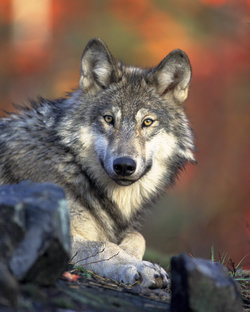
Wolves weigh 23 to 60 kg (50 to 130 lb), and are about 1 to 1.5 m (40 to 60 in) long with the tail being roughly a third of their body length. The males are larger than the females. The coloration runs from grey to grey brown but can vary through the canine spectrum of white, reddish, brown and black. The coat usually lacks any clear patterns except for paintings around the eyes. In areas where the ground is snow covered white wolves are far more common. Very old wolves get a greyish tint in their coat.
The wolf anatomy differs on several points from the dog. Most obvious is a pre-caudal gland on the over side of the tail, close to the base, that is not present on dogs. The wolf usually has golden-yellow eyes, longer legs, larger paws and more pronounced jaws. The body of the wolf is built for long distance running, with a rather thin chest and powerful back and leg muscles. Wolves can move over great distances and the wide paws make sure deep snow hampers them less than their prey. A wolf often seems more massive than a dog of comparable weight due to the extra bulk of the coat. The coat is built up of two layers, with hard guard hairs to repel water and dirt and a thick woolly undercoat to keep it warm. The wolf changes coat two times a year, during spring and autumn. Females tend to have a thicker winter coat and keep it further into the spring than males. The wolves and most larger dogs share the same tooth configuration: The upper jaw has 6 incisors, 2 canines, 8 premolars, and 4 molars. The bottom jaw has 6 incisors, 2 canines, 8 premolars, and 6 molars. The canines are by far most important, as they are used to catch and hold prey. One common reason for wolves to starve is tooth damage after being kicked by larger prey. The oldest recorded free wolf was 16 years old. There has been reports of captive wolves reaching 20 years (not much unlike dogs). However the mean age of wolves is rather low. The mortality among pups is high; few survive the first winter. The most significant mortality factors for grown wolves are hunting and poaching by humans, car accidents, conflicts with other wolves, and wounds from hunting prey. All diseases that affect dogs also affect wolves, including mange and rabies, and can from time to time wipe out the wolf population in an area. Wolves adjust rather well to fluctuations in prey populations, so mass starvation is unusual.
Wolves can sustain their population under a heavy pressure, as long as the alpha pairs are not killed.
|