 The wolf belongs to the canine family and is regarded as an ancestor of the domestic dog.
Maned Wolf |
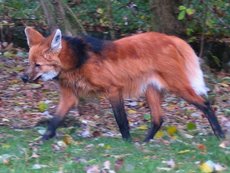
The maned wolf of South America is a magnificent animal with a pointed muzzle and very large erect ears. It derives its name from the characteristic mane on its neck which stands erect when it scents danger. Its body is covered with long, reddish-brown hair. Almost the entire animal is black, including the mouth, the back and the tail. The tip of the tail, chin and throat are sometimes white. Description: The maned wolf stands about three feet tall at the shoulder and weighs about 50 pounds. It looks like a long-legged fox, with a reddish-brown coat and a mane along its back. Its ears are large and long (7 inches), its throat and tip of the tail are white, and its legs are mostly dark. Range: This wolf lives in central and southeastern Brazil, Paraguay, eastern Bolivia, and northern Argentina. Habitat: The maned wolf inhabits open forest, savanna, and marshland. Shy Animals: Contrary to popular stories of wolves being the most cunning and fearless of predators, maned wolves are actually shy and nocturnal animals. They prefer to stay alone and come together only during the mating season. It is wary of man and does not attack unless provoked.Diet: Maned wolves are omnivorous, eating small mammals, insects, reptiles, birds, bird eggs, fruits, and vegetation. Threats to Survival: Habitat destruction is the main threat to maned wolves. They have almost no natural enemies, but nevertheless are in great danger because they needs wide, uninterrupted spaces. In addition, people kill these wolves for their body parts, believed to have magical properties. Conservation: The National Zoo has been working to protect maned wolves for nearly 30 years and coordinates the collaborative, inter-zoo Maned Wolf Species Survival Plan, which includes breeding maned wolves, studying them in the wild, protecting their habitat, and educating people about them. At the National Zoo: Maned wolves can be seen in the yard next to the East African crowned crane, across from the kangaroos and emu, and Parking Lot A. Ancestors of the maned wolf are thought to have spread from North to South America about two million years ago. Broken away from other wolf species in North America, the maned wolf evolved into what it is today.The maned wolf stands up to 3 feet in height, and 4 feet in length. It very seldom weighs over 50 pounds, though it's long legs make it appear to be much heavier. By nature, it lives in dry, shrubby forests, and grasslands with swampy regions that grow high, lush vegitation. The wolf's long legs enable it to see above tall grass, making it easy to spot prey as well as hide from it. The wolf's toes can also be splayed apart, allowing it to walk on marshy grounds.
|