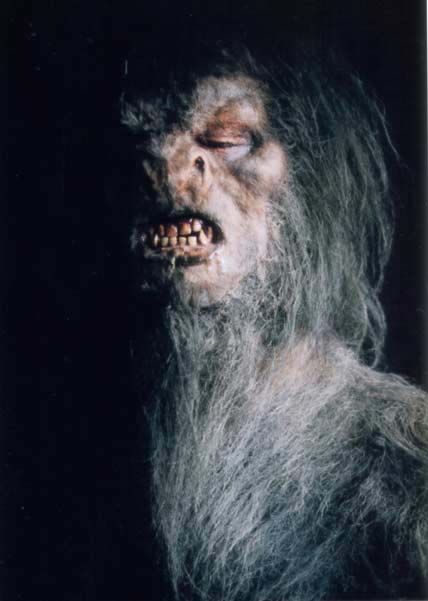
Werewolf |
Many European countries and cultures have stories of werewolves, including Greece (lycanthropos), Spain (hombrelobo),Bulgaria (varkolak, vulkodlak), Serbian (vukodlak) Russia (volkodlak), Poland (wilkołak), Romania (vârcolac), England (werwolf), Germany (Werwolf), France (loup-garou), Galicia, Portugal and Brazil (lobisón, lupisomem), Lithuania (vilkolakis and vilkatlakis) and Estonia (libahunt). In northern Europe, there are also tales about people changing into bears. In Norse mythology, the legends of berserkers may be a source of the werewolf myths. Berserks were vicious fighters, dressed in wolf or bear hides; they were immune to pain and killed viciously in battle, like a wild animal. In Latvian mythology, the Vilkacis was a person changed into a wolf-like monster, though the Vilkacis was occasionally beneficial. A closely related set of myths are the skin-walkers. These myths probably have a common base in Proto-Indo-European society, where the class of young, unwed warriors were apparently associated with wolves.
Shape-shifters similar to werewolves are common in myths from all over the world, though most of them involve animal forms other than wolves. See lycanthropy for more information. In Greek mythology the story of Lycaon supplies one of the earliest examples of a werewolf legend. According to one form of it Lycaon was transformed into a wolf as a result of eating human flesh; one of those who were present at periodical sacrifice on Mount Lycaon was said to suffer a similar fate. The Roman Pliny the Elder, quoting Euanthes, says (Historia Naturalis viii. 22) that a man of the Antaeus family was selected by lot and brought to a lake in Arcadia, where he hung his clothing on an ash tree and swam across. This resulted in his being transformed into a wolf, and he wandered in this shape nine years. Then, if he had attacked no human being, he was at liberty to swim back and resume his former shape. Probably the two stories are identical, though we hear nothing of participation in the Lycaean sacrifice by the descendant of Antaeus. Herodotus (iv. 105) tells us that the Neuri, a tribe he places to the north-east of Scythia were annually transformed for a few days, and Virgil is familiar with transformation of human beings into wolves (see Eclogues viii. 98). In the novel Satyricon, written about year 60 by Gaius Petronius, one of the characters recites a story about a man who turns into a wolf. There are women, so the Armenian belief runs, who in consequence of deadly sins are condemned to pass seven years in the form of a wolf. A spirit comes to such a woman and brings her a wolf's skin. He orders her to put it on, and no sooner has she done this than the most frightful wolfish cravings make their appearance and soon get the upper hand. Her better nature conquered, she makes a meal of her own children, one by one, then of her relatives' children according to the degree of relationship, and finally the children of strangers begin to fall a prey to her. She wanders forth only at night, and doors and locks spring open at her approach. When morning draws near she returns to human form and removes her wolf skin. In these cases the transformation was involuntary or virtually so. But side by side with this belief in involuntary metamorphosis, we find the belief that human beings can change themselves into animals at will and then resume their own form. France in particular seems to have been infested with werewolves during the 16th century, and the consequent trials were very numerous. In some of the cases -- e.g. those of the Gandillon family in the Jura, the tailor of Chalons and Roulet in Angers, all occurring in the year 1598, -- there was clear evidence against the accused of murder and cannibalism, but none of association with wolves; in other cases, as that of Gilles Garnier in Dole in 1573, there was clear evidence against some wolf, but none against the accused; in all the cases, with hardly an exception, there was that extraordinary readiness in the accused to confess and even to give circumstantial details of the metamorphosis, which is one of the most inexplicable concomitants of medieval witchcraft. Yet while this lycanthropy fever, both of suspectors and of suspected, was at its height, it was decided in the case of Jean Grenier at Bordeaux in 1603 that lycanthropy was nothing more than an insane delusion. From this time the loup-garou gradually ceased to be regarded as a dangerous heretic, and fell back into his pre-Christian position of being simply a "man-wolf-fiend." In Province of Prussia, Livonia and Lithuania, according to the bishops Olaus Magnus and Majolus, the werwolves were in the 16th century far more destructive than "true and natural wolves," and their heterodoxy appears from the Catholic bishops' assertion that they formed "an accursed college" of those "desirous of innovations contrary to the divine law." In England, however, where at the beginning of the 17th century the punishment of witchcraft was still zealously prosecuted by James I of England, the wolf had been so long extinct that that pious monarch was himself able (Demonologie, lib. iii.) to regard "warwoolfes" as victims of delusion induced by "a naturall superabundance of melancholic." Only small creatures such as the cat, the hare and the weasel remained for the malignant sorcerer to transform himself into, but he was firmly believed to avail himself of these agencies. The werewolves of the Christian dispensation were not, however, all considered to be heretics or viciously disposed towards mankind. "According to Baronius, in the year 617, a number of wolves presented themselves at a monastery, and tore in pieces several friars who entertained heretical opinions. The wolves sent by God tore the sacrilegious thieves of the army of Francesco Maria, duke of Urbino, who had come to sack the treasure of the holy house of Loreto, A wolf guarded and defended from the wild beasts the head of St. Edmund the martyr, king of England. St. Odo, abbot of Cluny, assailed in a pilgrimage by foxes, was delivered and escorted by a wolf" (A. de Gubernatis, Zoological Mythology, 1872, vol. ii. p. 145). Many of the werewolves were most innocent and God-fearing persons, who suffered through the witchcraft of others, or simply from an unhappy fate, and who as wolves behaved in a truly touching fashion, fawning upon and protecting their benefactors. Of this sort were the "Bisclaveret" in Marie de France's poem (c. 1200), the hero of "William and the Werewolf" (translated from French into English about 1350), and the numerous princes and princesses, knights and ladies, who appear temporarily in beast form in the German fairy tales, or Märchen. See "Snow White and Rose Red," where the tame bear is really a bewitched prince. The lubins or lupins of France were usually female and shy in contrast to the aggressive loup-garous. Indeed, the power of transforming others into wild beasts was attributed not only to malignant sorcerers, but also to Christian saints. Omnes angeli, boni et mali, ex virtute naturali habent potestatem transmutandi corpora nostra ("All angels, good and bad have the power of transmutating our bodies") was the dictum of St. Thomas Aquinas. St. Patrick transformed Vereticus, a king in Wales, into a wolf; and St. Natalis cursed an illustrious Irish family with the result that each member of it was doomed to be a wolf for seven years. In other tales the divine agency is still more direct, while in Russia, again, men are supposed to become werewolves through incurring the wrath of the devil.
Werewolf legend originated from the countryside around German town Colongne and Bedburg in 1591. At that time Europe was under the dark shadow of ignorance and superstitions. Towns were underdeveloped and people lived near woods. The fear of wolves was like a nightmare. Their attacks were so frequent that people even feared to travel from one place to another. Every morning, countryside people would find half-eaten human limbs on their fields. They tried their best to kill those bloodthirsty creatures. But one day the inhabitants of the German town Colongne and Bedburg made a horrible discovery that altered the history of wolf killing. An age-old pamphlet describes those shivering moments vividly. A few people cornered a wolf and set their dogs upon it. They attacked it with sharp sticks and spears. Surprisingly the ferocious wolf did not run away; it stood up and turned into a middle-aged man. They could recognize the wolf shaped man; he was Peter Stubbe of the same village. This Peter Stubbe was the first werewolf mankind has ever faced with. Stubbe was put on the torture wheel where he confessed 16 murders including two pregnant women and thirteen children. The history behind his downfall was rather strange. He had started to practice sorcery when he was only 12 and was so obsessed with it that he even had tried to make a pact with the Devil. Wearing a magic girdle he started to attack his enemies, real or imaginary, for revenge. After several months, he took the guise of a wolf and continued his evil with more brutality. In the wolf form he used to tear up victims’ throats and suck warm blood. Gradually his thirst for blood grew and he roamed around fields in search of prey.
|